
A daily, pocket-sized history of America's working people, brought to you by The Rick Smith Show team.
Episodes

Wednesday Jul 28, 2021
Wednesday Jul 28, 2021
On this day in labor history, the year was 1917.
That was the day more than 10,000 African-Americans marched down New York City’s 5th Avenue in what is known as the Silent Parade.
The protest came in the aftermath of the July 2, East St. Louis race riot and a number of lynchings in Texas.
Organized by black scholar and activist W.E.B. Du Bois, James Weldon Johnson and the NAACP, the Silent Parade protested lynching and anti-black violence.
Children led the march, dressed in white.
Women, who were also dressed in white, followed them. Men dressed in dark suits, marched behind. It was considered the first major public protest of racial violence in the United States.
Alexis Newman describes the scene as the parade proceeded to Madison Square.
“The marchers carried banners and posters stating their reasons for the march. Both participants and onlookers remarked that this protest was unlike any other seen in the city and the nation. There were no chants, no songs, just silence.”
Some signs read, “Mother, Do Lynchers Go To Heaven?” and “Mr. President, Why Not Make America Safe For Democracy?”
Protesters hoped President Woodrow Wilson would make good on his election promises to promote rights for blacks.
But Wilson took no action. In fact, he opposed anti-lynching legislation and continued segregationist policies in federal offices.
In an editorial for The New York Age,James Weldon Johnson pointed out, “that their brothers and sisters, people just like them, were “Jim-Crowed” and segregated and disfranchised and oppressed and lynched and burned alive in this the greatest republic in the world, the great leader in the fight for democracy and humanity.”
Tuesday Jul 27, 2021
Tuesday Jul 27, 2021
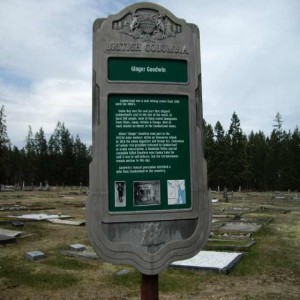
That was the day miner’s president Ginger Goodwin was shot dead in British Columbia.
His murder sparked Canada’s first general strike, in Vancouver the following week.
Goodwin had arrived in British Columbia 8 years earlier and found work in the Cumberland Mines on Vancouver Island.
He considered working conditions in the mines absolutely appalling and began advocating for safety and organizing miners. He was soon blacklisted after participating in a two-year coal miner’s strike for recognition on the island.
He moved to Trail, British Columbia, where he emerged as a Socialist Party candidate in the 1916 elections.
He was also elected president of the International Union of Mine, Mill and Smelter Workers, District 6, the vice-president of British Columbia’s Federation of Labor and the head of the local Trades and Labor Council.
He openly expressed his opposition to Canada’s entry into the war, stating that workers were now employed in killing each other.
He was found unfit for military duty after a medical exam.
That was, until he led a strike for the eight-hour day at Consolidated Mining & Smelting.
It was the world’s largest lead and zinc smelter and a key munitions producer during the war.
His status was quickly changed to make him eligible for conscription.
He fled to the Cumberland Hills, where he hid out for months to avoid the draft.
On this day, Goodwin was shot dead by a Dominion Police Special Constable.
He was brought back to Cumberland, where thousands turned out for his funeral in a mile long procession.
The Vancouver labor movement was outraged by Goodwin’s murder and called a one-day general strike on August 2 to protest his killing.
Monday Jul 26, 2021
Monday Jul 26, 2021
On this day in labor history, the year was 1877.
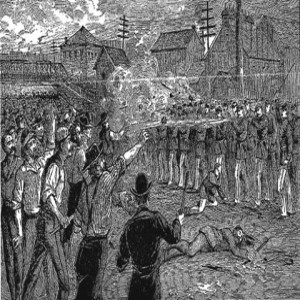
That was the day striking railroad workers in Chicago clashed with police in the “Battle of the Halsted Street Viaduct.”
The Great Railroad Strike had reached the nation’s railroad hub, and began there three days earlier.
Switchmen from the Michigan Central traveled to freight shops in yards across the city, calling workers out to strike.
Soon lumbershovers, butchers and industrial workers joined the strike.
By the time the Battle began, police had already clashed with unarmed strikers twice. Historian Richard Schneirov describes the scene leading up to the Battle: “The city was now preparing itself for a full-scale insurrection, even though violent confrontations were rooted in police attacks on non-violent crowds.”
Previous confrontations centered in the railroad yards. Now, strikers’ actions spilled over into the neighborhood of Pilsen, where they lived.
Thousands gathered along Halsted Street between 12th and 16th streets.
The police arrived, attempting to disperse the crowd.
They chased strikers south and as Schneirov describes, “emptied their revolvers into the masses of humanity.”
The crowd pelted the police with stones in defense and chased them over the viaduct.
As word spread of the pitched battle, stockyard workers from nearby Bridgeport walked off the job.
They marched along Halsted Street, with butcher knives in hand, to support the strikers under attack.
The crowd on Halsted swelled to more than 10,000 as workers continued to battle police.
By evening, 30 workers had been shot dead, hundreds more were seriously wounded.
But the strike continued to spread more fiercely.
Streetcar stockmen, stonecutters, gas workers, glasscutters and others joined the strike.
The city was shut down for another week until railroad bosses finally rescinded wage cuts.
Sunday Jul 25, 2021
Sunday Jul 25, 2021
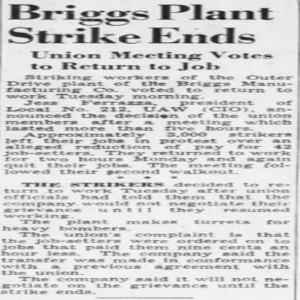
On this day in labor history, the year was 1944. That was the day Local 212, UAW workers at Briggs returned to work.
Briggs was directly involved in war production. 3000 workers, on two shifts, made ball turrets for heavy bombers.
Workers on both shifts walked off the job when management at the Outer Drive plant carried out a series of transfers and layoffs, while expecting the same level of production.
It had been the second walkout in a week. Management set a precedent of refusing to settle grievances of any kind.
They routinely snubbed the union, insisting they take any and all grievances to the War Labor Board.
Local 212 president, Jess Ferrazza noted it would take anywhere from 12-18 months to get a grievance processed.
Workers were fed up with waiting. He added “it was like a fireman with a water bucket running around trying to put fires out.
Management never cooperated.
If the grievance were a justifiable one, they would not settle it.
They would tell you to get the workers back to work.”
The strike came on the heels of a contentious State CIO convention earlier in the month.
There, delegates debated the merits of the no-strike pledge. Local 212 delegates were among a full third of total delegates, who made known their opposition to the pledge. Ferrazza argued that, “the no-strike pledge has tied labor’s hands and as long as our hands are tied, the corporations will continue their attacks on labor.”
Briggs workers agreed to return to their jobs on the promise of direct settlement of grievances.
They also geared up for the national CIO convention, intent on overturning the wartime, no-strike pledge.
Saturday Jul 24, 2021
Saturday Jul 24, 2021
On this day in labor history, the year was 1877.
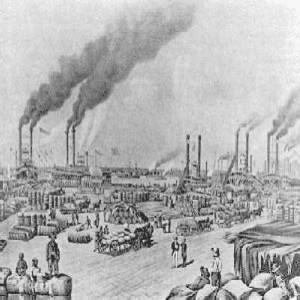
That was the day Louisville sewer workers walked off the job.
The Daily American reported that, “hundreds of black sewer-men stopped work, and began marching through the streets, armed with picks and shovels.”
They went from one sewer construction site to the next, calling workers out to strike for higher wages.
The Great Railroad Strike of 1877 had clearly impacted workers in Mid-Southern cities like Memphis, Nashville and Louisville.
Historian Steven J. Hoffman observes these workers were able to capitalize on strike threats to advance their demands. Railroad bosses for the Louisville, Nashville & Great Southern had rescinded pay cuts for mechanics and engineers.
But they had not raised wages for the lowest paid laborers.
Those laborers joined sewer workers in their march through the city.
By nightfall, the mass of integrated strikers marched to the L&N depot, clashing with police.
Some broke off to march to the Short-Line Depot, smashing windows of the mayor’s house on their way.
Though the crowd was largely dispersed by early morning, Louisville was now in the midst of a general strike.
Hoffman describes the scene: “workers at the metal shops and foundries downtown struck for higher wages.
There were reported strikes at the Kentucky lead and oil works, all the downtown furniture factories, woolen mills, horse collar makers, and tobacco factories as well as by many of the city’s coopers, brick makers and African-American levee workers.
Many of the demands of these workers, which tended to focus on wages and hours, were met and they returned to work quickly.”
Though Southern cites avoided railroad strikes, for the most part, they could not evade the Great Strike’s impact on other sectors of the workforce.
Friday Jul 23, 2021
Friday Jul 23, 2021
On this day in labor history, the year was 1913.
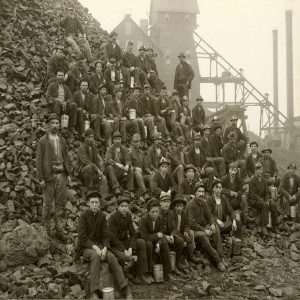
That was the day 9,000 copper miners in the Keweenaw region of Upper Peninsula, Michigan went on strike.
Organized by the Western Federation of Miners, the strike raged on for over eight months, witnessed devastating tragedy in a Christmas Day fire and ended in bitter defeat.
The strike was waged over basic issues like the eight-hour day, higher wages, mine safety and union recognition.
But strikers were also fed up with the company’s paternalism and intrusion into their personal lives.
They also worried for their jobs with the introduction of labor saving machinery. The WFM succeeded early on in shutting down the mines. But the copper barons wouldn’t budge.
By August, many mines reopened with scab labor.
Later that month, deputies shot two strikers dead and wounded two others, as they returned home from attempting to collect strike benefits.
The incident became known as the Seeberville massacre.
Striking miners were absolutely devastated when on Christmas Day, 73 people, mostly children, were trampled to death during a Christmas party and benefit at the Italian Hall in Calumet.
Witnesses remembered seeing a man with a Citizens Alliance button just moments before someone yelled ‘Fire!’ that caused the stampede.
Soon after the Italian Hall disaster, WFM president Charles Moyer was shot by a Citizens alliance mob, then loaded, bleeding, onto a train bound for Chicago.
By April, the union was broke, the strike was broken and miners resolved to return to work. Bosses would only rehire strikers once they had turned in their union cards.
The copper mines in the region would finally be organized some 30 years later in a campaign led by Mine Mill during the years 1939 to 1943.
Thursday Jul 22, 2021
Thursday Jul 22, 2021
On this day in labor history, the year was 1916.
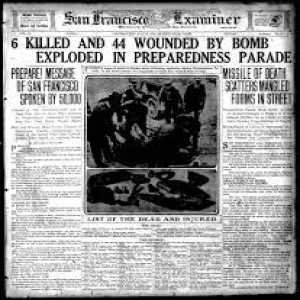
That was the day a bomb rocked the Preparedness Day parade in San Francisco, killing 10 and injuring at least 40.
The Chamber of Commerce and the newly formed Law and Order Committee organized the parade to shore up support for war production and eventual entry into World War I.
But isolationist sentiment in San Francisco remained strong. Anti-war activists prepared pamphlets and protests for the march.
Many trade unionists were opposed to entry into the war.
Some considered the parade a response to the combative longshoreman’s strike raging on the docks for weeks.
San Francisco had been a strong union town for years, known for strikes and labor disputes.
1916 was an election year and already, the city had been rocked by a number of strikes.
Business interests launched an open shop campaign and began targeting labor radicals.
They found their scapegoats in labor leaders Tom Mooney and Warren Billings, who were framed and convicted for the bombings.
Journalist Carl Nolte points out that Mooney and his assistant had been trying to organize workers at the city’s largest streetcar company, United Railroads.
He notes their convictions were based on perjured testimony and doctored evidence. Incredibly, one of the prosecution’s star witnesses wasn’t even in town that day!
But the convictions served to vilify labor militants as terrorists.
Fremont Older, editor of two local newspapers, discovered the frame-up evidence.
He and many others, including Upton Sinclair and Clarence Darrow campaigned for years to free the two men. They were finally released after 22 years, in 1939.
The actual bombers were never found, though some have speculated that Anarchists of the Galleanist movement were likely responsible.
Wednesday Jul 21, 2021
Wednesday Jul 21, 2021
On this day in labor history, the year was 1877.
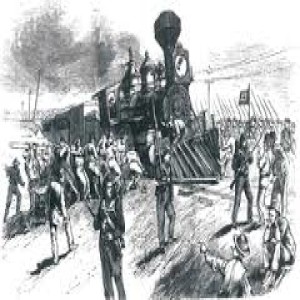
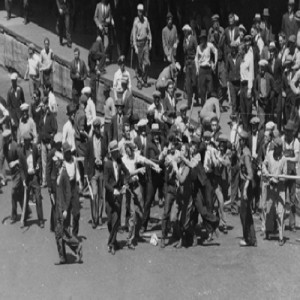
That was the day that some of the worst violence of the Great Railroad Strike erupted in Pittsburgh.
The strike started days earlier. It is contested as to whether it began in Martinsburg, West Virginia or Baltimore.
The strike spread rapidly along the Baltimore & Ohio Railroad to New York State, Pennsylvania and throughout the Midwest.
At its height, the Great Railroad Strike involved well over 100,000 workers.
The strike began on the Pennsylvania Railroad on the 19th.
Management repeatedly tried to move trains through the yards and was confronted by angry strikers. Pennsylvania Guardsmen were called out.
The strikers presented the railroad with their demands: they wanted an end to double engine trains that required fewer workers, wages reinstated, reinstatement for their fired coworkers and an end to pay grades.
Local militia sided with the strikers and refused to show for duty.
When thousands of strikers gathered at the depot, the Pennsylvania National Guard moved unsuccessfully to disperse them.
Then they fired on strikers, killing 20 and wounding 29.
The strikers were infuriated by the deadly aggression and drove guardsmen into a nearby railroad roundhouse.
Word spread quickly throughout the city of the massacre, launching a virtual general strike. Workers began seizing arms wherever they could find them.
They set fires to dozens of railroad buildings, burned down the Union Depot, destroyed over 100 locomotives and more than 1000 freight and passenger cars.
The next day, guardsmen shot their way out of the roundhouse, killing 20 more as they were chased from the city.
A total of 3000 federal troops would be necessary to quell strikers’ fury by month’s end.
Tuesday Jul 20, 2021
Tuesday Jul 20, 2021
On this day in labor history, the year was 1934.
That was the day that came to be known as Bloody Friday.
Minneapolis Teamsters had been on strike for three days in their third strike of the year.
The trucking bosses had reneged on their May settlement.
They refused to recognize union organization of inside workers.
In the period between strikes, the union had documented hundreds of cases of discrimination.
Now, 7,000 Teamsters effectively shut down trucking throughout the city. Local 574 leaders established a daily strike bulletin.
The Organizer, as it was called, would serve to guide strikers to victory.
In his book, Revolutionary Teamsters, historian Bryan Palmer notes that the first few days of the strike had been quiet.
Then on this day, police attempted to break the picket lines by running what seemed to be a lone scab truck through the lines.
It was later discovered the truck was moving no merchandise, but was used to draw strikers into a confrontation.
When flying pickets moved to stop the truck, they were ambushed. Police opened fire on unarmed pickets and then sprayed those who attempted to escape with buckshot.
At least 48 were wounded. Striker Henry Ness and Unemployed Council supporter John Belor were killed.
Palmer notes that Ness had been shot point blank in the chest. Doctors pulled 38 slugs from his body.
“His death bed injunction repeated word of mouth among the strikers: “Tell the boys not to fail me now.”
More than 40,000 turned out to pay their respects to the World War I veteran and father of four. Palmer adds that, “Bloody Friday had lasted a matter of minutes.
But its’ meaning would leave a mark on the very fabric of Minneapolis socio-economic relations…”
Monday Jul 19, 2021
Monday Jul 19, 2021
On this day in labor history, the year was 1934.
That was the day San Francisco’s Central Labor Council voted narrowly to end the general strike, then in its fourth day.
It had been one of three historic strikes that turned the tide towards industrial organizing in the 1930s.
It emerged as part of the ongoing longshoreman’s strike, which started in May.
The decision was controversial.
Longshoremen and seamen raged that leadership of the strike had been torn from them by more conservative elements.
As author of Workers on the Waterfront, Bruce Nelson puts it, “after two and a half months on strike, literally thousands of arrests, at least six deaths and hundreds of serious injuries, the men and their families were holding the line.
But their allies were gradually cutting the ties of solidarity that had been the strike’s lifeblood.”
The shipping bosses forced a vote for arbitration from the longshoremen, and withoutthe seamen.
As Nelson notes, this served to drive a wedge between the two unions, creating a rift that would only deepen.
The two would continue to strike until the end of July.
But the strike left longshoremen emboldened.
They pushed back on the job, driving off scabs and establishing work rules and conditions ahead of the arbitrator’s ruling, which came in October.
The hiring hall was finally established.
While it was decided that the union and the shipping bosses would rule the hall jointly, the union controlled the position of dispatcher.
This meant the union determined hiring, which put an end to the despised ‘shape-up.’
The award also mandated wage raises and a coast-wide contract.
It would serve as a catalyst for the founding of the ILWU three years later.