
A daily, pocket-sized history of America's working people, brought to you by The Rick Smith Show team.
Episodes
Sunday Oct 29, 2023
Sunday Oct 29, 2023
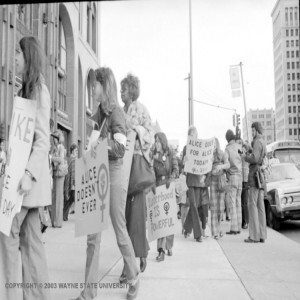
On this day in Labor History the year was 1975.
That was the day that the National Organization for Women, or NOW, called for a strike by women across the nation.
They called the action, “Alice Doesn’t Day.”
This referred to a critically acclaimed movie by director Martin Scorsese that came out the year before, entitled “Alice Doesn’t Live Here Anymore.”
The main character in the film is Alice Hyatte, who pursues her dream of being a singer after she is widowed.
It was lauded by feminists as a story of women’s empowerment.
NOW used the film title, and asked women to participate with the slogan “Alice doesn’t...you fill in the blank.”
Women were encouraged to participate in the day however they could, including refraining from volunteering, shopping, and if possible working for one day to demonstrate their importance to the economy.
Women who could not skip work, were asked to wear arm bands to show their solidarity with the cause.
In an interview published in the Chicago Tribune, NOW President Karen DeCrow explained, “There is a myth that women in the work force could go home, but if they did our economy would stop. If all the secretaries did not come to work, all things would stop.”
But not all women were excited about the day.
Some anti-feminist women decided to protest the day by wearing pink, baking cookies and performing other stereotypical female tasks.
While NOW called the event a success, Time magazine deemed it “spectacular failure.”
One critique was that the event reflected the white, middle class dominance of the women’s movement.
Working class women, and especially women of color, had a much more difficult time withholding their labor.

Sunday Oct 29, 2023
Sunday Oct 29, 2023
On this day in Labor History the year was 1861.
That was the day that the Pony Express made its last run and passed into legend.
The mail delivery service had lasted only a year-and-a-half, until it folded under competition from the newly completed transcontinental telegraph.
The idea for a faster western mail delivery service came from the owners of the wagon freight company Russel, Majors and Waddell.
At the time the railroad terminated in St. Joseph, Missouri.
The goal of the Pony Express Route was to cover the 2,000-mile route from St. Joe to San Francisco in ten days—half the time of competitors.
Riders would travel between one station and another station on horseback, switching horses as they went.
For this arduous job, the company targeted young men, sometimes in their teens.
The goal was to hire small men to keep the weight low for the horses.
The riders had to sign a pledge not to drink, gamble, fight or swear.
To back up the clean living, they were each issued a bible.
Riders were paid a minimum of $50 per month, in addition to room and board.
The riders faced many hazards from bad weather to thieves.
They often traveled across lands in dispute between the U.S. government and Native Americans, adding potential danger.
The fastest Express delivery ever was Lincoln’s Inaugural address, which made it to California in under eight days.
Perhaps the most famous person who claimed to be a pony express rider, was Buffalo Bill Cody, although it is unlikely he ever carried the mail.
He incorporated the pony express into his Wild West Show, turning the mail service into the stuff of legend
Friday Oct 27, 2023
Friday Oct 27, 2023
On this day in Labor History the year was 1948.
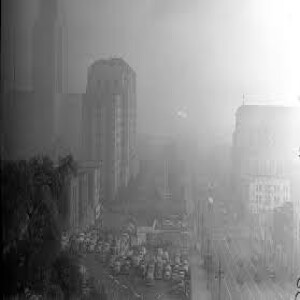
That was the day that a thick yellow fog rolled over the town of Donora, Pennsylvania just south of Pittsburgh.
Donora was a mill town, nestled in a valley on the bank of the Monongahela River.
By 1948, the town had grown to 14,000 people, who came to work in the town’s steel mills and the Donora Zinc Works.
For years the local residents had complained about the pollution that spilled from the plants.
Smog was a regular occurrence.
But this fog was even worse than usual.
A layer of cold air was trapping a noxious blend of nitrogen dioxide, sulfuric acid and fluoride pollution.
Twenty-four hours passed, and still the fog grew denser.
The police and local doctors began to receive reports of people having difficulties breathing.
The fog became so thick that residents could not see to drive.
For five days the smog hung over the town, until a rain fall began to break it up.
Nearly half of the towns’ residents became ill.
Twenty died.
U.S. Steel refused to take blame for the fog, even though they continued to run the plant as the deadly toxins continued to build.
According to a 2010 article by the Pittsburgh Post-Gazette, “Despite the efforts of industry to cast the tragedy as an “act of God,” the fatalities in Donora received national attention. The event changed the way air pollution was viewed, moving it rapidly from an aesthetic issue to a public health concern, and spurred local, state and federal officials to control toxic air pollution.”
In 2008 a Smog Museum opened with the motto “Clean Air Started Here.”
Thursday Oct 26, 2023
Thursday Oct 26, 2023
On this day in Labor History the year was 1837.
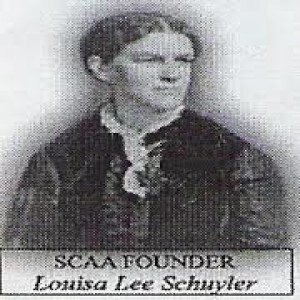
That was the day that Louisa Lee Schuyler was born in New York City.
She was dedicated to the causes of public health and welfare, especially for the poor.
This led her to help found the Bellevue Training School for Nurses in 1873.
It was the first nurse’s school in the United States based on the principals of Florence Nightingale, the English social reformer who established modern nursing practices.
Louisa had become concerned with the conditions found at the city’s public hospitals.
Along with three other women, she toured Bellevue hospital finding poor lighting, dire sanitary conditions, and even a laundry that had run out of soap.
The women wrote up a report about their findings.
They made the case that a professionally trained nursing staff would help remedy the situation.
The work of women during the Civil War had shown the potentially important role of nurses in providing medical care.
The women’s request was approved on a trial basis at Bellevue.
Bellevue hospital had opened its doors in 1736, making it the oldest continually running public hospital in the United States.
The first class of nursing students included just six women.
Early training focused on improving sanitary conditions at the hospital and seeing to patient comfort.
But instruction grew quickly to include basic medical training.
By 1879 enrollment had grown to more than sixty trainees.
Proud of their accomplishments, graduates wore a school pin.
Designed by Tiffany & Company, the pin portrayed a crane in the middle of a wreath of poppies.
The school operated for nearly a century, until the training program was incorporated into Hunter College.
Thursday Oct 26, 2023
Thursday Oct 26, 2023
On this day in Labor History the year was 1990.
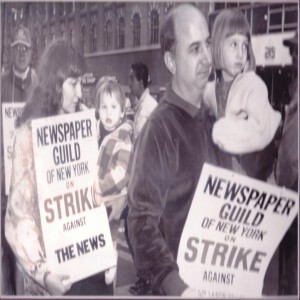
That was the day that eight of the ten unions at the New York Daily News went out on strike.
The paper had had one of the highest daily circulations in the United States.
The New York Daily News was owned by the Chicago-based Tribune Company.
The strike began when management demanded major concessions from the delivery drivers, essentially forcing them to strike.
Seven more unions joined them on the picket line.
In retaliation management brought in scab labor.
This caused a ninth union to join the walkout.
The Newspaper Guild workers had planned to honor the picket lines, but not go on strike themselves.
But according in an article in the Los Angeles Times, “said local Guild President Barry Lipton, the editorial employees decided almost immediately at an afternoon meeting to go on strike rather than to work with any “imported scabs and goons.”
Well known journalist Juan Gonzalez, was a strike leader for the local.
By using replacement workers, Daily News management was able to keep the paper in production.
But they found it much more difficult to get the paper distributed.
Even where they could make delivery, many newsstands refused to sell the struck paper.
The New York Times blamed this on intimidation from delivery drivers.
But they also acknowledged that some refused distribution “either out of sympathy for strikers or an unwillingness to offend pro-union customers.”
To support the strike, the unions put on a concert headlined by Lou Reed, along with Pete Seeger, Q-Tip from a Tribe Called Quest and other musicians.
The strike lasted for five months, prompting the Tribune to sell the paper.
Under new management the strike was finally settled.
Tuesday Oct 24, 2023
Tuesday Oct 24, 2023
On this day in Labor History the year was 1940.
That was the day that the federally mandated 40-hour work week went into effect for U.S. workers.
The 40-hour week had been passed as part of Fair Labor Standards Act in 1938.
Making five days of eight hour work the national standard had long been a top goal for labor.
For decades’ union members organized, demonstrated, when on strike, and even died for the right to work eight hours.
Labor argued that reducing the long, unregulated hours of toil was a matter of worker’s health and safety.
It was also a matter of dignity.
A more reasonable work week would give workers the time to spend with their families, to pursue other interests, and to have a full life outside of the grinding schedule demanded by many bosses.
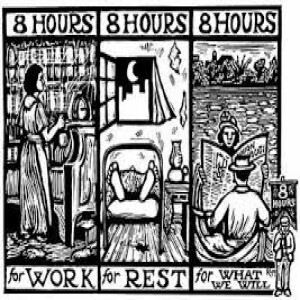
Before the turn of the twentieth century, the eight-hour day movement declared “Eight hours for work, eight hours for rest, eight hours for what we will!” as their motto.
In 1886, nationwide rallies and strikes for eight hours took place on May 1st.
Today, May Day is celebrated as a worker’s holiday around the world in remembrance of that struggle.
In 1888, the American Federation of Labor took up the cause, and the Carpenters union became the standard bearer for eight hours.
Ten years later the United Mine Workers union members won the eight-hour day.
In 1916, the Adamson Act made eight hours the standard for interstate railroad workers.
A decade after that, Ford Motor Company, a leader in U.S. industry established the forty-hour work week.
Each of these victories were a step along the way to making the eight-hour day a reality and the law of the land.
Tuesday Oct 24, 2023
Tuesday Oct 24, 2023
On this day in Labor History the year was 1995.
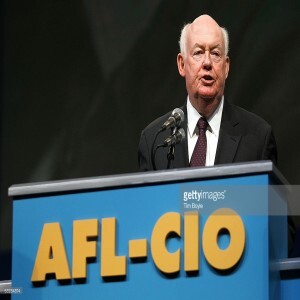
That was the day that the AFL-CIO Convention convened in New York City.
At the convention John Sweeney was elected president of the federation.
It was the first contested election for president in AFL-CIO history.
He ran with a slate of labor leaders, including Richard Trumka, who called themselves the “New Voice” slate.
Sweeney was the President of the Service Employees International Union.
He was a New Yorker, born in the Bronx.
He started his career in labor working for the International Ladies’ Garment Workers, then moving to SEIU as a union rep.
He represented SEIU Local 32B in New York City during two strikes of apartment maintenance workers during the 1970s.
In 1980 he was elected SEIU President, a post he held for fifteen years.
Membership in SEIU nearly doubled from 625,000 to 1.1 million under his leadership.
Sweeney gave a powerful speech for his candidacy at the convention.
He said, “Workers look at their paychecks, the political system and the public debate and wonder why nobody is speaking for me?
Then, in fear and frustration, they look for leadership to the Rush Limbaugh’s who seek scapegoats rather than solutions for the problems of stagnant wages, corporate greed and a fractured society.”
He pledged that under his leadership the AFL-CIO would move to commit more resources to organizing these workers.
When he won election, Sweeney held good to his campaign promise.
He initiated a new initiative, the Union Summer program, to involve college students in the labor movement.
He expanded organizing efforts in the South and Southwest.
John Sweeney served five terms as AFL-CIO President.
Sunday Oct 22, 2023
Sunday Oct 22, 2023
On this day in Labor History the year was 1934.
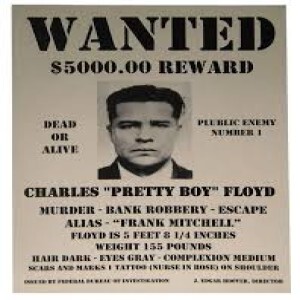
That as the day that the bank robber known as Pretty Boy Floyd was gunned down by federal agents in Ohio.
He was born Charles Arthur Floyd in 1904 in Georgia.
His family moved to Oklahoma when he was a boy.
Like many Oklahomans during this era, he fell on hard economic times.
Floyd turned to crime.
He did a four year stretch in a Missouri prison for a payroll robbery.
When he got out, he tried to get a job in the Oklahoma oil fields.
Unable to find work, Floyd took up bank robbing.
He robbed banks in Kentucky, Ohio and Missouri.
He got caught and convicted in Ohio, but escaped on his train trip to prison.
He made his way back to Oklahoma.
There he became a folk hero.
Locals called him the “Robin Hood of The Cookson Hills.”
Legend had it that Floyd destroyed mortgage papers when he robbed banks, winning him friends among farmers reeling from the Great Depression and the Dust Bowl.
Floyd became a national fugitive when he was accused of killing federal agents in Kansas City.
He denied he was involved in the killings.
- Edgar Hoover, head of the U.S. Bureau of Investigation, named Floyd Public Enemy Number One.
Finally, the law caught up with Floyd in an Ohio cornfield.
His body was returned to Oklahoma, where as many as 40 thousands came to his funeral.
Woody Guthrie remembered Floyd in song.
Saturday Oct 21, 2023
Saturday Oct 21, 2023
On this day in Labor History the year was 2001.
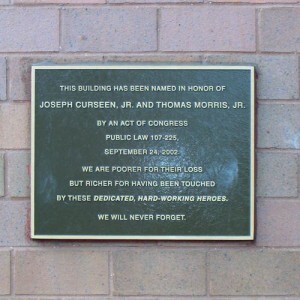
That was the day that Thomas Morris Jr. died from breathing in anthrax.
A week earlier he had been exposed to the deadly poison when an envelope containing the powdery substance was opened at the mail distribution center where he worked.
Thomas Morris was a member of American Postal Workers Union.
His union brother Joseph Curseen died two days later.
Both men worked at the U.S. Postal Service Brentwood Processing and Distribution Center in Washington D.C.
The poisoned letters were addressed to Senators Tom Daschle and Patrick Leahy.
More postal workers at a distribution center in New Jersey also fell ill from exposure to anthrax poisoned mail.
In total, twenty-two people were sickened by Anthrax that fall, from letters addressed to politicians and news outlets.
In addition to the injured, five people died, including a seven-month old infant who was visiting NBC news in New York City with his mother who worked there.
Coming the month after the September 11th attacks, the anthrax poisoning sent another wave of fear of terrorism throughout the United States.
The Brentwood distribution center was closed down for decontamination until December 2003.
When it reopened, the facility was renamed for the two fallen postal workers.
The next year, Senator Joe Lieberman gave an address to the APWU.
He said, “the postal workers who were exposed to anthrax, and still got the mail out and kept our system running—they are all proud union members. I know I’ll never forget that. And America won’t forget that. All of you at the APWU deserve our respect and our support.”
One person suspected of the poisonings committed suicide and the case was closed.
No one was ever convicted of the crimes.
Saturday Oct 21, 2023
Saturday Oct 21, 2023
On this day in Labor History the year was 1926.
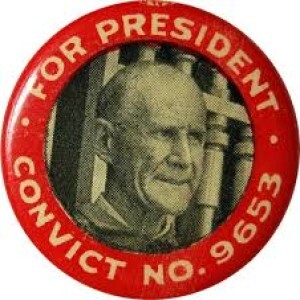
That was the day that one of the great labor leaders in U.S. history, Eugene V. Debs, died in Elmhurst, Illinois.
In 1894, Debs gained national attention when his American Railway Union launched a boycott in support of the striking workers of Pullman Palace Car Company.
The strike and the boycott were crushed by federal troops and a federal court.
Debs served six months in jail for his role in the boycott.
Later Debs again would go to jail for standing up for his beliefs.
He was convicted for speaking out against U.S. involvement in World War I.
He was among the founders of the Industrial Workers of the World in 1905.
He ran as a Socialist for President of the United States five times, receiving nearly a million votes running his campaign from a prison cell in 1920.
In 1891 Debs wrote an article for the Locomotive Firemen’s Magazine titled “The Unity of Labor”.
His words stand as an eloquent case for worker solidarity.
Debs wrote, “If workingmen were united in sympathetic bonds…if a bricklayer could comprehend the fact that he is dependent on the hod carrier;
if the locomotive engineer could grasp the fact that he is dependent on the locomotive fireman…
the interdependence of labor would at once constitute a bond of union, a chain whose links, forged and fashioned to hold workingmen in harmonious alliance, would girt them with a defense in every time of trouble and resist invasion, though assailed by all the plutocrats that ever cursed the earth.”
Debs spent his life trying to bring about this “harmonious alliance” of working people, and standing up for the causes of peace and justice.