
A daily, pocket-sized history of America's working people, brought to you by The Rick Smith Show team.
Episodes
Tuesday Nov 28, 2023
Tuesday Nov 28, 2023
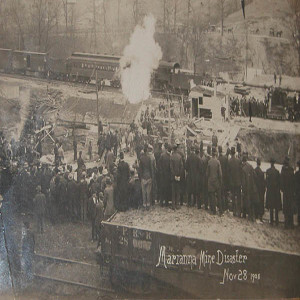
On this day in Labor History the year was 1908.
That was the day that an explosion at the coal mine in Marianna, in Washington County Pennsylvania claimed the lives of 154 miners.
It was one of the deadliest disasters in US mining history.
The Marianna mine was on the Pittsburgh coal seam, one of the richest coal deposits in the country.
The mine was operated by the Pittsburgh-Buffalo coal company.
It was considered by many to be a model operation.
The company houses that surrounded the mine were made of yellow brick, had hot and cold running water and electric lights.
This set them apart from other mining homes of the day.
By the early 1920s ninety percent of all mining homes were wood frame and less than twenty percent had electricity.
Yet even though Marianna was considered a model, disaster still struck.
Mining inspector Henry Louitt had been on site for two days leading up to the disaster.
On Saturday morning, he had just left a mine shaft.
According to newspaper reports he had found the mine “in perfect condition.”
Then shortly before 11 came a horrific explosion that left experts puzzled.
It was believed that a vein of natural gas caused the deadly blast.
Only one man, Fred Elinger, was rescued from the mine.
He gave a harrowing account of what happened to the Washington Observer.
He said, “I was working at laying brick in one of the entries and the first thing I knew a terrible explosion took place, which threw me some distance. My two buddies were also tossed some distance away. I heard them for a while and then all was quiet.”
Elinger was rescued, but 154 other men were not.
Monday Nov 27, 2023
Monday Nov 27, 2023
On this day in Labor History the year was 1910.
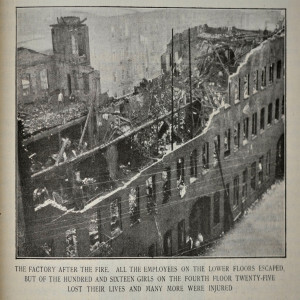
That was the day when thousands of people came to see the location where a fire had ravaged a sweatshop in Newark, New Jersey.
The day before, at least twenty-six women perished in the inferno.
The workers of the Alfred & Irving Wolf Muslin Undergarment Company made nightgowns.
On the morning of the fire there were more than 100 women crowded into the fourth floor workspace.
The fire broke out when a can of gasoline was knocked over in the lamp company located below the sweatshop.
The floors of the garment shop were wooden and strewn with fabric.
The fire spread quickly.
It roared up so fast—even though there was a fire station across the street, the fire crew could not get there in time.
It would become the worst fire in Newark’s history.
Desperate women tried to escape.
But the fire safety exits were not adequate.
Some of the women leapt to their deaths from the fourth story windows.
The fire became national news.
No one was ever held legally accountable for the conditions that led to the fire.
Less than a year and half later tragedy would strike again in the garment industry when the Triangle Shirtwaist Factory fire would claim the lives of 146 workers.
The events of the Newark fire faded into annals of history.
For years, no memorial marked the location.
Richard Greenwald, a dean at a nearby university, thought that the women who died deserved to be remembered.
As the 100th anniversary approached he found the graves of twenty-five of the women and organized a memorial ceremony.
He also helped create a bronze plaque to remember the site.
Sunday Nov 26, 2023
Sunday Nov 26, 2023
On this day in Labor History the year was 1829.
That was the day that William Sylvis was born in Armagh, Pennsylvania.
Growing up he was one of twelve children.
His father was a wagon maker and taught him the trade.
At the age of eighteen he became an iron working apprentice.
His skill took him to Philadelphia, where he found work.
But iron work was changing.
More and more foundries were hiring unskilled labor, or helpers, to assist in production.
They could pay these workers significantly less, and undercut the wages of the skilled iron moulders.
In response William joined his local iron moulders union.
But he knew if they were to really have any power as workers, they would need to join together with other locals.
In 1863 he brought together 21 locals to form the Iron Moulders International Union.
Three years later, he embarked on an even more ambitious project—forming a national labor organization for workers across the trades.
Under his leadership the National Labor Union grew to 300,000 members strong.
William shared his thoughts on the importance of labor in a speech to the Iron Moulders Union in 1864 saying quote,
“If workingmen and capitalists are equal co-partners, composing one vast firm by which the industry of the world is carried on and controlled, why do they not share equally in the profits? Why does capital take to itself the whole loaf, while labor is left to gather up the crumbs? Why does capital roll in luxury and wealth, while labor is left to eke out a miserable existence in poverty and want?”
Sadly after all these years, William’s questions are still being asked today.
Sunday Nov 26, 2023
Sunday Nov 26, 2023
On this day in Labor History the year was 1947.
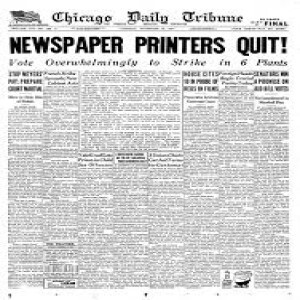
That was the day that front page of the Chicago Tribune printed a banner headline “Newspaper Printers Quit!”
1,600 members of the International Typographical Union Local 16 had gone out on strike against six Chicago newspapers.
The key reason for the strike was wages.
The union also wanted the publishers to agree to only hire union labor.
The walkout was part of a wave of printers’ strikes in the United States and Canada.
In all, union members from 43 newspapers from 27 cities went on strike.
Most newspapers were able to keep printing during the walkouts.
But many had to reduce the number of editions or make changes in how the paper was produced.
According to the an article published by the Associated Press, “Some are using a photoengraving process to circumvent their composing rooms while others continue to the use of normal methods.”
The Chicago strike wore on for twenty-two months.
The strike also became an important labor struggle after the passage of the Taft-Hartley legislation.
The legislation, approved by Congress earlier that year over President Harry Truman’s Veto, restricted the rights of labor unions including outlawing the closed shop.
Since the typographical unions were some of the oldest trade unions in the country, the strike became an important battleground over how Taft-Hartley would be interpreted.
The American Newspaper Publishers Association hoped that Taft-Hartley could be a tool in smashing the strike.
The courts sided with the publishers and demanded the union drop their demand for a closed shop.
The union did win a ten-dollar raise, a little more than two-thirds the amount they asked for during the strike.
Friday Nov 24, 2023
Friday Nov 24, 2023
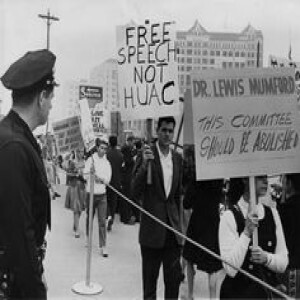
On this day in Labor History the year was 1947 that was the day that the US House of Representatives found ten Hollywood writers and directors in contempt for their alleged ties to Communism.
The decision was based on the House Un-American Activities Committee’s finding the ten to be in contempt the week before.
More than forty screenwriters, directors and producers were brought before the committee to testify about allegations of rampant Communist activities in the movie-making industry.
During the Cold War fear of Communism reached a fevered pitch.
This included the fear that Communists were infiltrating Hollywood to spread their message to the public through the movies.
Ten refused to answer the committee’s questions or to name names of other potential Communists.
Each of the ten was fined $1,000, sentenced to a year in prison, and blacklisted from working in Hollywood.
Perhaps the most well-known of the ten was one of Hollywood’s leading screenwriters, Dalton Trumbo.
He served 11 months in federal prison for refusing to cooperate with House Un-American Activities Committee.
While he was blacklisted he wrote the screen play for Roman Holiday, the romantic film starring Gregory Peck and Audrey Hepburn.
Since Trumbo could not take credit for the film, another screenwriter friend put his name on it.
Roman Holiday won the 1953 Academy Award for best screenplay.
Three years later another Trumbo script, The Brave One also received the Academy Award.
Finally, in 1960 Trumbo worked on Stanley Kubrick’s acclaimed film Spartacus.
Kubrick refused to remove Trumbo from the credits—busting the blacklist.
In 2015, actor Bryan Cranston starred in a film about Trumbo’s life.
During the House Un-American Activities Committee’s hearings, the Screen Actors Guild passed a resolution that members had to disavow any ties to the Communist Party.
They also elected actor Ronald Regan president of their union.
Thursday Nov 23, 2023
Thursday Nov 23, 2023
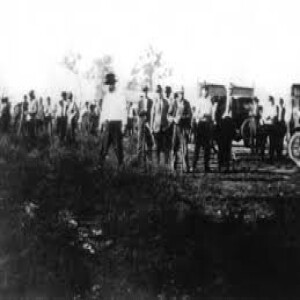
On this day in Labor History the year was 1887. That was the day of the Thibodaux Massacre, in Louisiana just southwest of New Orleans.
Thousands of African American sugar cane workers had gone out on strike. Before the Civil War, sugar cane, like other southern crops had been harvested by enslaved labor. After the war, planters put laws and practices into place to control and repress the newly freed labor force.
By the late 1880s one of those practices was paying sugar cane workers in scrip. Instead of actual money workers received scrip only redeemable at the planters’ stores. This let planters set the prices for goods and keep their workers in debt.
The Knights of Labor began to organize the bayou sugar workers through their Local Assembly 8404. The union presented the Louisiana Sugar Producers Association, which represented 200 of the largest planters, with a list of demands.
The list included the end of scrip payment and a small wage increase. The planters refused. The union called a strike to begin on November first, during a key time in the sugar harvest.
Outraged planters brought in scabs to replace the strikers and militia troops to protect the scabs. They evicted strikers from their plantation homes. Many evicted black workers made their way to the black section of Thibodaux.
White armed men began to picket around the black neighborhood. Two of these white picketers were fired on by an unknown person.
In retaliation, for more than two hours the vigilantes rained gun fire on black strikers and their families. At least thirty people, and possibly many more were killed. The strike was crushed.
Wednesday Nov 22, 2023
Wednesday Nov 22, 2023
On this day in Labor History the year was 1909.
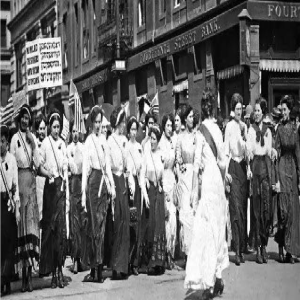
That was the evening when a crowd began to gather at the Cooper Union in the heart of New York City’s shirtwaist garment making industry.
A meeting had been called by the International Ladies’ Garment Workers’ Union Local 25 to discuss whether garment workers should go out in a general strike.
Working conditions and pay throughout the industry were abysmal.
It was common for worker to toil eleven hours a day, with only a thirty-minute lunch break seven days a week.
But organizing all of these workers was a challenge.
Many spoke various dialects of Yiddish or Italian, so organizing had to take place in multiple languages.
But slowly the organizing efforts began to build and show results.
Pickets and walk outs were held against some employers.
The union called a meeting to discuss what to do next.
They voted to strike after a stirring speech in Yiddish from Clara Lemlich, a founder of ILGWU Local 25.
The strike came to be known as the Uprising of the 20,000.
It lasted until February.
In a settlement more than 300 factories agreed to recognize the union.
The factory workers also won improvements in wages, hours, and conditions.
A song from the Educational Department of the ILGWU captured the spirit of the strike.
The lyrics begin, “In the black winter of nineteen nine, when we froze and bled on the picket line, We showed the world that women could fight and we rose and won with women’s might.”
The song continued, “And we gave new courage to the men Who carried on in nineteen ten and shoulder to shoulder we’ll win through, Led by the I.L.G.W.U.”
Wednesday Nov 22, 2023
Wednesday Nov 22, 2023
On this day in Labor History the year was 1946.
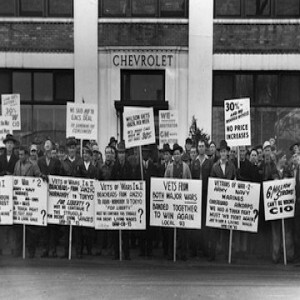
That was the day that 320,000 United Auto Workers went out on strike against General Motors.
The strike was part of a wave of work actions that washed over the country after World War II.
Workers were growing more and more frustrated that company profits were soaring while workers’ wages remained stagnant.
During the war, most unions had abided by ‘no strike’ pledges.
But once the war was over, workers wanted their fair share of the growing American economy.
In just one year 5 million workers participated in more than 4,500 strikes.
The GM strikers demanded a thirty percent pay increase.
Walter Reuther, President of the UAW, also insisted that the company could meet this demand without raising the prices of their vehicles.
He asked the company to open their books, so workers and the public could see the full details of company’s profits.
GM refused.
They characterized Reuther as a socialist for even making such an outrageous request.
During negotiations, Harry Coen, the GM assistant director of personnel, told President Reuther, “Why don’t you get down to your size and get down to the type of job you are supposed to be doing as a trade-union leader, and talk about money you would like to have for your people, and let the labor statesmanship go to hell for a while."
The GM strike lasted for 113 days.
The workers won a 17.5 percent pay increase, and improvements to vacation and overtime.
But they did not get to look at the GM books or gain a say in how GM vehicles were priced.
Wednesday Nov 22, 2023
Wednesday Nov 22, 2023
On this day in Labor History the year was 1888.
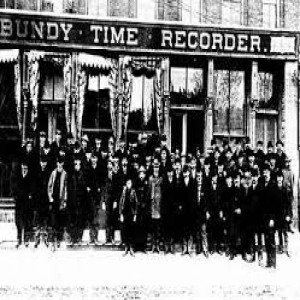
That was the day that William Le Grand Bundy is credited with inventing something that has become a daily part of life for millions of workers.
His “Time Recorder” was a time clock that could record when workers arrived and left their jobs each day.
The clock would record the time on a paper tape when a worker inserted his or her individualized, numbered key.
Bundy was a jeweler and inventor from New York.
After inventing his time clock, he went into business with his brother Harlow and founded the Bundy Manufacturing Company.
With the growth of factories, there was more and more demand for time clocks.
They were considered more exact and efficient than human time keeping.
Keeping track of hours worked and labor costs became an essential part of squeezing every drop of profit out of the industrial workforce.
The Bundy brothers located their company in the city of Binghamton, in southern New York.
Business thrived.
Other inventors put their own twist on the time clock.
At the turn of the twentieth century, the Bundy company merged with several other time-keeping outfits, forming the International Time Recorder Company.
Workers across the United States, Canada and Europe had their work hours recorded by International Time clocks.
Later the company became part of International Business Machines, or IBM, one the world-wide leaders in workplace technologies.
Over the years, new innovations have been introduced to employee time keeping, such as time cards and computer-linked swipe cards

Sunday Nov 19, 2023
Sunday Nov 19, 2023
On this day in Labor History the year was 1915. On that sad day, Industrial Workers of the World organizer and songwriter, Swedish-born Joe Hill, was executed in Utah. In 1914, Hill was framed for the murder of a grocer and his son in Salt Lake City. The evidence was circumstantial at best.