
A daily, pocket-sized history of America's working people, brought to you by The Rick Smith Show team.
Episodes
Saturday Jan 20, 2024
Saturday Jan 20, 2024
On this day in labor history the year was 1909.
That was the day the United States Supreme Court decided the case of Moyers v. Peabody.
The case grew out of the Colorado Labor Wars, a series of back-to-back strikes in 1903 and 1904 in precious metals mines and ore mills.
The Colorado National Guard meted out violent assaults, arrests and deportations against strikers, often on orders from Governor James Peabody.
The state militia routinely rounded up strikers and union leaders, detained them for weeks in bullpens and ignored habeas corpus petitions.
Western Federation of Miners president, Charles Moyer arrived in Telluride during a strike to find these repressive conditions.
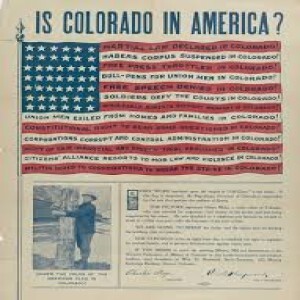
He signed a poster that read, “Is Colorado in America?”
The poster included an image listing the many violations of basic democratic rights on the American flag.
Moyer was arrested in March 1904 for desecration of the American flag on the poster.
He was detained on the grounds of military necessity, even after the courts ordered his release.
His case traveled through the state and federal courts until the Supreme Court ruled.
They held that “the governor and officers of a state National Guard, acting in good faith and under authority of law, may imprison without probable cause a citizen of the United States in a time of insurrection and deny that citizen the right of habeas corpus.”
The ruling radicalized the labor movement.
Many concluded there could be no justice through the court system.
A later case successfully challenged the ruling on the basis that claims of insurrection were subject to judicial review.
The ruling, however controversial, still stands and was invoked after 9/11 in the 2004 ruling Hamdi v Rumsfeld.
Saturday Jan 20, 2024
Saturday Jan 20, 2024
On this day in labor history, the year was 1898.
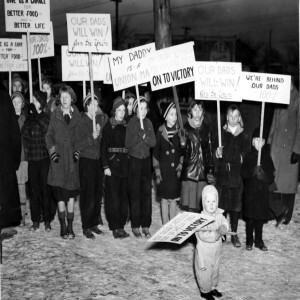
That was the day workers in the textile mills of New Bedford, MA walked out on strike.
They were organized along craft lines into five different unions.
Regardless of craft, mill owners inflicted a 10% wage cut, which would prove devastating, given whole families worked in the mills.
When the wage cut took effect, spinners effectively shut down twenty-two mills owned by nine companies.
Having formed an amalgamated strike committee, weavers, loom fixers, carders and slasher-tenders all stayed away in support.
Workers leaders like Samuel Gompers, Eugene V. Debs and Daniel De Leon of the Socialist Labor Party all visited the strikers to give encouragement and inspiration.
Debs alone acknowledged the role of women in the strike as workers and not just as wives, mothers, daughters or sisters.
Before the strike, there had already been discord over strike demands.
The weavers insisted on adding the fines issue.
They constituted 40% of mill workers and their job duties included correcting the mistakes of other trades.
Manufacturers routinely fined weavers for material deemed imperfect, yet still profited from selling their products.
The fines system wrought havoc on weaver families and they wanted it abolished.
The rest of the unions sympathized with their plight, but insisted the strike would fail unless they focused solely on the issue of wage cuts.
The weavers persisted and the demand stuck.
By April, the strike collapsed.
Workers went back with nothing gained.
But the strike proved that workers across craft lines could strike and support each other in an industrial manner.
It also proved that men and women workers could effectively organize a strike and picket together.
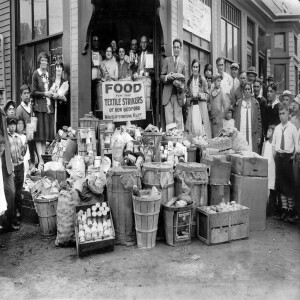
*The Photo is from the 1928 strike of Textile workers in New Bedford MA
Tuesday Jan 16, 2024
Tuesday Jan 16, 2024
That was the day the United Electrical Workers joined the national post-war strike wave.
200,000 UE members walked off the job at General Electric, Westinghouse, and General Motors’ Electrical Division.
Across the country, reduction of hours and phony job reclassifications led to a 30% wage cut, while years of wartime grievances piled up.
All this led to the demand for $2 a day pay raises.
Many of these workers were young women on strike for the first time.
They had spent much of the war fighting piecework and gender based divisions of labor.
Reports from the picket lines showed overwhelming support among the strikers and from the general public.
Older male coworkers who built the UE joined young women strikers on the line.
At the GE Mazda Lamp Works in Youngstown, Ohio, steelworkers joined women strikers to bolster picket lines.
In Lynn, MA, signs of women picketers read, “We Want to Live, Not Just Exist,” and “Let the Pipes Freeze-They Don’t Care If We Freeze,” in response to maintenance crews allowed to pass.
In Bloomfield, N.J., six restaurants turned their establishments over to the strikers.
GE president Charles Wilson complained bitterly of the 12,000 or so picketers that blocked the gates of the GE Schenectady Plant.
Strikers across the country faced violent confrontations and beatings as police on horseback waded through crowds.
Philadelphia strikers retaliated by pouring marbles onto the street.
Workers at GE and Westinghouse would eventually settle for 18 cents an hour, less than what they had hoped but more than either company had been willing to give.
Management would remain in shock for years at the level of solidarity among strikers and the community.
Sunday Jan 14, 2024
Sunday Jan 14, 2024
On this day in labor history, the year was 1888
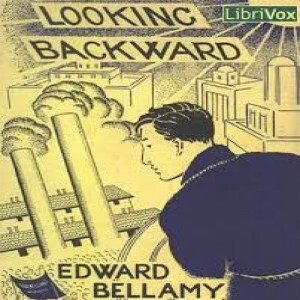
That was the day novelist, Edward Bellamy published his futuristic, utopian novel, Looking Backward, 2000-1887.
The protagonist, Julian West, wakes up in the year 2000, to find that industry has been nationalized and wealth, goods and services have been equitably distributed.
People work less, retire early and enjoy greater leisure.
Looking Backwards was so popular that by 1900 only Uncle Tom’s Cabin and Ben-Hurhad sold more copies.
Bellamy’s utopia solved problems of capitalism through development of a socialistic society.
Bellamy denied he was a socialist and instead referred to his vision as Nationalist.
The novel sparked a political movement virtually overnight.
Bellamyites, as they were called, formed Nationalist Clubs across the country.
They attempted to organize a Peoples’ Party around these clubs, which soon dissolved into the Populist movement of the 1890s.
Looking Backwards was a response to the Gilded Age world of monopolies and trusts, depressions and often-violent class convulsions.
Bellamy was quick to indict the banks, the railroads and the corrupt political system that served them.
Sociologist Arthur Lipow argues in his book, Authoritarian Socialism in America: Edward Bellamy and the Nationalist Movement, that while Bellamy may have expressed anti-capitalist sentiments, his future is one in which there is no democratic public life or political process.
For Lipow, Bellamy’s particular collectivist view is militaristic and bureaucratic, and does away with representative bodies of any kind.
However, Socialist Party leader Eugene V. Debs credited his own political development in part, to reading Looking Backwards.
He noted that, regardless of whether Bellamy considered himself a socialist, his novel generated popularity and enthusiasm for socialist ideas, causes and politics.
Saturday Jan 13, 2024
Saturday Jan 13, 2024
On this day in labor history, the year was 1968.
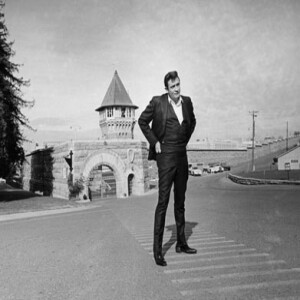
That was the day Johnny Cash played Folsom Prison.
The Man in Black had played numerous free prison concerts before.
Country-music Legend Merle Haggard remembered seeing him perform at San Quentin a decade earlier.
Columbia Records recorded the two concerts at Folsom for release.
It was this recording that many credit with the revitalization of Cash’s career.
His daughter, Rosanne believes the 1968 appearance signified her father’s own personal liberation; “…that was the moment that he came into the light…when he embodied who he really was.”
Performing with The Tennessee Three, June Carter, Carl Perkins and The Statler Brothers, Cash hit the charts with Folsom Prison Blues, which sold more than three million copies at the time.
He also took the opportunity to advocate for prison reform and prisoner’s rights, providing congressional testimony on the subject in the early 1970s.
His brother told the BBC in an interview, "He identified with the prisoners because many of them had served their sentences and had been rehabilitated in some cases, but were still kept there the rest of their lives. He felt a great empathy with those people."
Cash might not have actually shot a man in Reno, but he always sided with the underdog.
His songs highlighted the workingman’s life, from the sharecroppers, coalminers and auto workers, to the railroaders, truckers and prison chain gangs.
Cash always gave an unromanticized view of hard living and hard labor, as well as interracial and class solidarity.
Friday Jan 12, 2024
Friday Jan 12, 2024
On this day in labor history, the year was 1942.
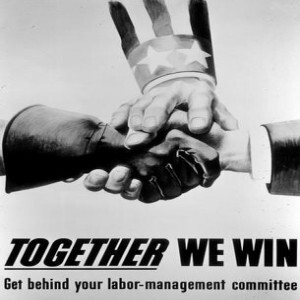
That was the day President Franklin Roosevelt established the National War Labor Board under Executive Order 9017.
The Board was designed to mediate and settle disputes in the various defense industries.
Its purpose was to prevent any strikes or lockouts that would interfere with war production.
The War Labor Board consisted of twelve representatives: four each from industry, labor and the public.
It established procedures for dispute resolution and detailed the scope of grievances, arbitrations and award enforcement.
The Board had the authority to issue binding agreements and to recommend government seizure of plants involved in work stoppages.
It instituted the “Little Steel” Formula to allow for cost of living wage increases, in an effort to stem inflation.
In exchange for the no-strike pledge, it instituted “maintenance of membership” in unionized workplaces, which made union membership automatic for new hires and mandated employer collection of union dues.
During the war, it imposed tens of thousands of wage-dispute settlements and wage agreements.
In a 1942 case against General Motors, the Board mandated equal pay for equal work for women and minorities. ]
Those critical of the Board opposed the no-strike pledge and compulsory arbitration as clampdowns on Labor’s power and independence.
They argued it was stacked with open-shop advocates, enforced wage controls and freezes, and encumbered workers with endless red tape, run-arounds and delays in resolutions.
Labor historian Steve Fraser notes that after the 1942 elections, pro-business appointees made union organizing efforts throughout the South and in the retail and service sectors difficult.
It ceased to function at the end of 1945, though it set precedents for arbitration that are still in use today.
Thursday Jan 11, 2024
Thursday Jan 11, 2024
On this day in labor history, the year was 1937.
That was the day “The Battle of the Running Bulls” occurred at GM’s Fisher Plant No.2 in Flint, Michigan.
It marked the turning point in the Great Flint Sit-Down Strike.
Company guards attempted to stop food deliveries to the strikers.
When confronted, the guards cleared out and the food deliveries resumed.
The guards however, reported to the local police that strikers were holding them captive.
The Flint police soon arrived, throwing tear gas into the picket lines and through plant windows.
The sit-downers responded with plant fire hoses and slingshots loaded with door hinges.
The police continued to launch tear gas at the picketers.
Then the crowd pelted police with any debris they could find.
It was at this point that the police began firing into the crowd, seriously wounding 16.
Genora Johnson of the Women’s Auxiliary speaking from the sound truck called her women to action.
She recollected in 1976, “That’s when I appealed to the women of Flint. I said, there are women down here, the mothers of children, and I beg of you to come down here and stand with your husbands, your loved ones, your brothers, your sweethearts… Then I saw the first woman struggling and I noticed when she started to break through and come down, that a cop grabbed her coat, and she just kept on coming. As soon as that happened other women broke through and… the cops didn’t want to fire into the backs of women. When the women did that, the men came naturally and that was the end of the battle.”
The Women’s Auxiliary would continue to play a vital role in the strike.
Thursday Jan 11, 2024
Thursday Jan 11, 2024
On this day in labor history, the year was 1885.
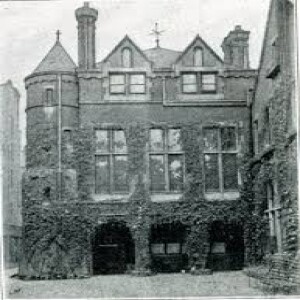
That was the day the Toynbee Hall, the first university settlement house opened its doors to the poor and working class communities of East London.
The Industrial Revolution had created a new set of social conditions, those of high unemployment and slum housing, crime and infant mortality.
The vicar of St. Jude’s, Canon Samuel Barnett and his wife, Henrietta hoped to combat poverty by having students settle in with the poor and working class to provide services and fight for social reforms.
They named the settlement house in honor of their friend, economist and labor leader, Arnold Toynbee, who helped to organize trade unions and establish public libraries throughout East London.
In its early days, Toynbee Hall championed the rights of minority immigrants, including Jews and the Irish, developed adult education and language courses, evaluated industrial working conditions and provided free legal advice.
More aligned with Liberal rather than Labour politics in Britain, reformers at Toynbee Hall looked to build the health of the nation by fighting for welfare reform legislation.
It became a public forum for political debates and historical societies and blazed the path for the rise of the Settlement House movement in Britain and the United States.
Three years after its’ opening, Jane Addams would open Chicago’s famed Hull House.
Other settlement houses like Henry Street Settlement in New York City, founded by Lillian Wald, soon followed.
Though bombed in the Nazi Blitzkrieg in 1940, Toynbee Hall continues its vision of a future free from poverty and its mission to support people and communities to break down the barriers that trap them in poverty in a bold, engaged, and open environment to this day.
Thursday Jan 11, 2024
Thursday Jan 11, 2024

A daily, pocket-sized history of America's working people, brought to you by The Rick Smith Show team.
On this day in labor history, the year was 1922.
That was the day Chicago Building Trades began to split over the much-hated Landis Award.
The Building Trades had always enjoyed strong solidarity built through years of sympathy strike action.
By 1921, they were involved in a bitter dispute with the city’s employers, who had been on the open-shop offensive since the end of the World War I.
Contractors attempted to impose deep wage cuts and instituted a lockout when the Building Trades refused to go along.
Judge Kenesaw Landis, who sent close to one hundred IWW members to prison during World War I, arbitrated the dispute and issued his award that fall.
Considered a major blow to the building trades, his award outlined eight points on behalf of employers.
It imposed deep wage cuts of anywhere from 15%-40%, practically abolished the right to strike, and undermined years of established work rules.
As the Chicago Federation of Labor and Building Trades Council geared up for the fight, the employers created their own “Citizens Committee” to enforce the award.
The Chicago Federation of Labor noted that of the Committee’s 176 members, only 54 were based in the city and of those, only one had any connection with the industry.
On this day, the CBTC called for a strike.
Some unions refused to abide by the call.
The Building Trades split, with the Carpenters and Painters among those in favor of striking versus the Bricklayers, Electricians and Ironworkers, voting to honor the award.
A reported 60,000 building tradesmen walked off the job anyway, but the strike soon failed.
The Trades continued to erode the award’s strength and by 1926, many local agreements simply superseded its enforcement.
Monday Jan 08, 2024
Monday Jan 08, 2024
On this day in labor history, the year was 1980.
That was the day Robert Goss, president of the Oil, Chemical and Atomic Workers, called a nationwide strike against the oil industry.
The union sought to renegotiate for higher wages and better medical and dental plans in the second year of a two-year contract.
24-hour pickets were set up immediately.
For a good portion of the strike, workers at many of the refineries stopped strikebreaking scabs from entering.
But some refineries used management and contract workers to maintain production levels effectively.
Strikers confronted scabs daily and in a few instances, faced violence on the picket lines.
At least one manager crossing picket lines was charged with second-degree assault, after having rammed his car into a picketer at a Texaco refinery in Washington State.
In Texas City, the deaths of two contract workers at an Amoco refinery made news when Amoco refused to allow a union representative to accompany an OSHA inspector through the site.
Amoco sought a restraining order against OSHA and accused the agency of interjecting itself into a labor dispute.
At Houston’s Atlantic–Richfield, women mobilized to form picket lines in defiance of an injunction against union pickets.
In Los Angeles, area unions including UAW, UE, ILWU and the Teamsters formed the Los Angeles Harbor Council in solidarity with the strike.
On March 1, the Council conducted a one-day shutdown of the L.A. ports and strike support rally that demanded “Victory to the OCAW Strike!”
Oil workers would stay out fourteen weeks before the strike was finally settled.
They successfully won pay increases, and increases in employer contributions to the medical plan and a dental plan for the first time.