
A daily, pocket-sized history of America's working people, brought to you by The Rick Smith Show team.
Episodes
Saturday Feb 17, 2024
Saturday Feb 17, 2024
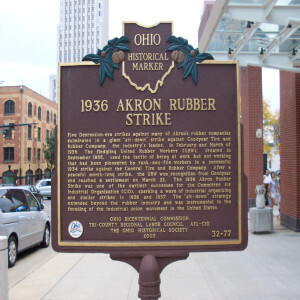
On this day in labor history, the year was 1936.
That was the day more rubber workers sat down in Akron, Ohio.
Tire builders in Goodyear’s Plant 2, Department 251-A sat down when 700 coworkers were laid off. Goodyear had been running four, six-hour shifts.
They hoped to reduce the workforce by implementing three, eight-hour shifts with no increase in pay. Management moved quickly to fire all of the strikers.
By the 17th, all 4000 workers at Goodyear voted to strike over the layoffs and firings, speed-up and the new shift hours and pay.
The enormous, 11-mile facility was immediately shut down.
In his book, Strike! historian Jeremy Brecher indicates that few if any were union members.
The United Rubber Workers was hesitant to associate itself with the sit-down.
Rubber workers organized themselves.
They set up 24-hour pickets at dozens of gates, built striker shanties and set their demands.
After six days, the URW sanctioned the strike.
Brecher describes the scene: “The company…secured an injunction against mass picketing. 10,000 trades people from across the city gathered with lead pipe and baseball bats to stop 150 sheriffs’ deputies from opening the plants.
The Summit County Central Labor Council guaranteed a general strike if Law and Order League vigilantes carried out a threatened March 18 attack on picket lines.
The vigilante movement was paralyzed. Federal mediators demanded a return to work and arbitration.
Workers responded, "No, no, a thousand times no, I'd rather die than say yes."
Finally, Goodyear capitulated on most of the demands, except formal recognition of the union.
Rubber workers returned to work largely victorious.”
After renewed struggles, workers finally won union recognition a year later.
Saturday Feb 17, 2024
Saturday Feb 17, 2024
On this day in labor history, the year was 2011.
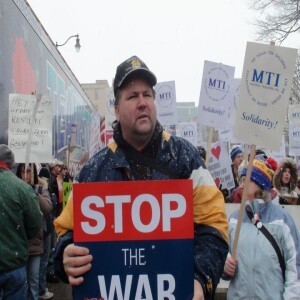
That was the day Madison Public School teachers held a sickout, in opposition to Governor Scott Walker’s anti-labor assaults.
Walker had introduced Assembly Bill 11.
Later known as Act 10, this union-busting bill proposed the elimination of collective bargaining rights for public sector workers regarding health and pension benefits, limited wage increases, eliminated dues collection and mandated annual union recertification.
Immediately, tens of thousands of protesters descended on the state capitol, chanting, “Kill the Bill,” and took part in hearings to voice their opposition.
Area schools remained closed for days as protests continued to grow throughout the spring.
While parts of Act 10 have been ruled unconstitutional in the years since, the legislation has nonetheless wreaked havoc.
A recent series in Milwaukee’s Journal-Sentinel, titled “Act 10 at Five,” examined how public school teachers have fared since the Madison Uprising.
They found that 75% of school districts are losing teachers, retirements have surged, less are entering the profession and most job-hop to the highest salary offers.
Teachers’ unions like MTEA and WEAC report major losses.
MTEA notes that membership is down by 30%. WEAC reports that membership and dues collections were cut in half and there are difficulties in organizing new teachers.
Seniority rights have evaporated and layoffs are increasingly tied to performance.
Annual salary growth has slowed, stopped or reversed.
Teacher morale is low in many districts.
Teachers often complain of additional unpaid duties, larger class sizes and more performance reviews.
There are new restrictions on attire, speech and political activities.
If there is any good news, it is that unions survive annual recertification and remaining members are more active and engaged in union work.
Thursday Feb 15, 2024
Thursday Feb 15, 2024
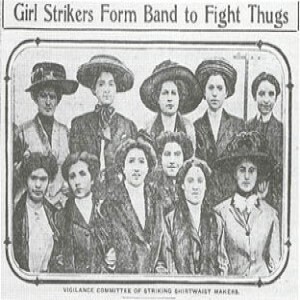
As many as 30,000 young, predominantly immigrant Jewish women went back to work after a bitter 11-week strike.
They faced down their bosses, police and the courts. Arrests and fines drained much of the union’s funds.
Young union leaders like Clara Lemlich had been arrested 17 times and suffered 6 broken ribs.
Women garment workers spent most of the winter running to union meetings, handing out leaflets, walking picket lines, raising funds and distributing strike benefits.
Many smaller shops settled in workers’ favor early on in the strike.
By mid-February, closed shop demands kept many workers on the picket lines.
The strike ended with partial, but real victories. Garment workers won the 52-hour workweek, 4 paid holidays, employer-paid tools and materials, collectively bargained wages and more.
The ILGWU started the strike with 100 members and had 20,000 by the end.
All but 14 of the city’s 353 shops signed contracts.
But many garment workers continued to face unsafe working conditions like locked doors and flimsy or non-functioning fire escapes.
Safety-related demands would not be addressed until after the 60,000 strong cloak makers strike the following summer.
One of the largest factories and worst offenders was Triangle ShirtWaist.
Workers there went back with no agreement.
147 would die a year later in a tragic fire.
In the aftermath, basic fire safety principles were finally established and implemented in New York State workplaces.
These formed the foundations for many modern day fire safety practices, like exit signs and doors, better ventilation and sprinkler systems, fire alarms and drills.
Wednesday Feb 14, 2024
Wednesday Feb 14, 2024
That was the day 300 commercial laundresses in Kansas City walked off the job, demanding a union.
Male laundry delivery drivers successfully organized the previous summer.
They soon joined the women on the picket lines.
The Employers’ Association had financed an open-shop drive since the beginning of the war.
The laundry companies refused to grant wage increases to the drivers.
They also refused to acknowledge the women’s demand for a union.
The Women’s Trade Union League tried to hold hearings about the strike at the Hotel Muehlebach.
But the Hotel refused to allow striking black workers into the building.
As a result, their white coworkers refused to testify.
When the hearings were finally moved, the women told of intolerable conditions.
Laundresses complained of filthy workplaces and potential firetraps.
They reported that laundry owners had put together their own private police force.
These guns for hire assaulted women strikers, breaking one’s arm, another’s wrist and injuring many more in hopes of deterring them from pressing on with their demands.
In the 6th week of the strike, 25,000 more workers of Kansas City called a general strike.
According to historian Maurine Weiner Greenwald, “they supported the laundry workers’ demands for increased wages, union recognition and enforcement of state regulations regarding hours and working conditions.”
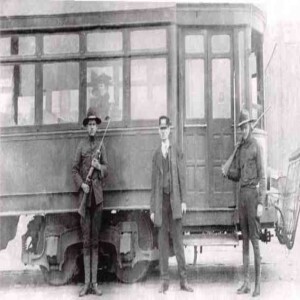
Greenwald notes the general strike was relatively peaceful until the Kansas City Railway attempted to run streetcars with scab labor.
Finally, the laundry companies agreed to union recognition and later promised wage increases.
They soon reneged. But the show of solidarity among workers provided key lessons for future labor struggles in Kansas City.
Wednesday Feb 14, 2024
Wednesday Feb 14, 2024
On this day in labor history, the year was 1937.
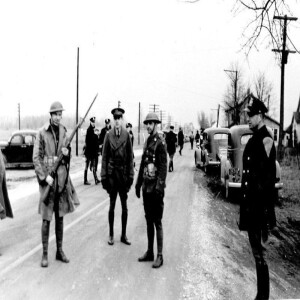
That was the day Indiana Governor, M. Clifford Townsend, dispatched State National Guard troops to Anderson, Indiana.
The national strike against GM had just ended in victory for the union two days earlier.
UAW forces were emboldened by the militancy, solidarity and public support for the union in Flint. But Anderson was a company town.
It was home to GM’s Guide Lamp and Delco-Remy divisions.
GM employed over 11,000 of the town’s 40,000 residents.
Guide Lamp workers struck in late December and Delco-Remy plants closed to prevent sit-downs.
Foremen visited workers in their homes, demanding signatures for back-to-work petitions.
The Citizens League for Industrial Security whipped almost half the town into an anti-union frenzy.
The entire month of January was so marred by anti-union violence and intimidation, the strike had to be abandoned.
When the national strike ended, the UAW organized a victory meeting.
It was held virtually under siege by an anti-union mob.
Victor Reuther recalled he aged 10 years that night.
Anti-union violence broke out the next evening at the Gold Band Tavern.
The bar owner shot and wounded at least 10 UAW members.
Union backup headed to Anderson. Fearing UAW forces, the Indiana National Guard was deployed and Madison County was placed under martial law for 10 days.
In the classic history of the Flint Sit-Down, Sidney Fine explains that anti-union sentiment began to break down once workers learned GM had been forced to eliminate incentive pay.
The union newspaper proclaimed: “The men and women who fought on the picket line; who withstood the terror of the vigilantes; who kept their faith under trying conditions; these people changed the conditions in the shops.”
Tuesday Feb 13, 2024
Tuesday Feb 13, 2024
That was the day the National Association for the Advancement of Colored People was founded.
During the early years of the 20thcentury, the NAACP developed legal strategies to challenge anti-Black violence and segregation.
W.E.B. DuBois, Ida B. Wells, Archibald Grimke and Florence Kelley were just a few of the white and black intellectuals and activists who founded the organization.
They sensed the urgency for a civil rights organization in the wake of the 1908 Race Riot in Springfield, IL.
They hoped to combat the rapid growth of lynchings and Jim Crow statutes.
Membership ballooned to almost 90,000 in less than 10 years, with more than 50 branches nationwide.
These leaders opposed the gradualism of Booker T. Washington and fought to convince whites of the need for racial equality.
The NAACP investigated lynchings and targeted disfranchisement and segregation through a series of lawsuits.
They established a Legal Defense Fund that organized support for the Scottsboro Boys and similar cases.
They undertook the campaign to overturn the ‘separate but equal’ doctrine of Plessy v. Ferguson.
This resulted in the 1954 landmark decision, Brown v. Board of Education.
The NAACP played a central role in the Civil Rights movement with Rosa Parks as its secretary.
They helped to organize the Montgomery Bus Boycott, were centrally involved in the campaign to integrate schools in Little Rock, Arkansas, and mobilized for the 1963 March on Washington for Jobs and Freedom.
They also worked successfully towards the 1964 Civil Rights Act and the 1965 Voting Rights Act.
The NAACP continues its important advocacy work today with some 425,000 members.
Tuesday Feb 13, 2024
Tuesday Feb 13, 2024
On this day in labor history, the year was 1981.
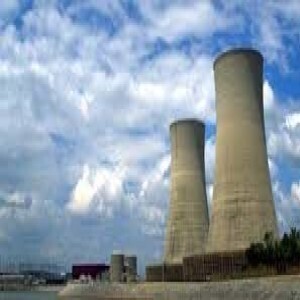
That was the day at least eight workers at Sequoyah I nuclear reactor in Tennessee were exposed to radioactive coolant.
The reactor was part of the vast Tennessee Valley Authority that provided electrical power to the region.
Sequoyah I had just been commissioned and was already off to a bad start.
First, on January 19, 1981, a generator tube malfunctioned, forcing a complete shut down.
Then on February 11, an operator error triggered an emergency alert.
An Auxiliary Unit Operator was working his first day on the new job without proper training.
He inadvertently opened the wrong valve during a safety test.
The operator misunderstood his instructions and recognized his mistake immediately.
But when he tried to alert the control room, they were too busy responding to the developing crisis to answer his call.
Reactor water sprayed for 10 minutes before it was finally shut off.
As many as 14 workers were contaminated by the coolant.
Some scientists contend that the release of reactor vessel water was inadvertent and part of the design of the cooling system.
Others argue that, in order to cut costs, management had decided to use radioactively contaminated water as emergency coolant rather than the more expensive fresh, uncontaminated water.
Steam leaks, tube malfunctions and overflowing drainage tanks were just some of the reported failures at the plant in the following years.
Between 1985 and 1988, Sequoyah was forced to shut down again after an independent review concluded that the plant did not comply with current safety standards.
Today the plant supplies electricity to more than 1.3 million homes.
Saturday Feb 10, 2024
Saturday Feb 10, 2024
On this day in labor history, the year was 1973.
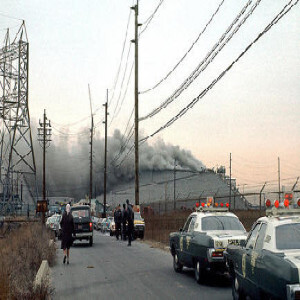
That was the day the worst industrial disaster in Staten Island took place.
Staten Island housed the world’s largest Liquefied Natural Gas storage tank.
The Texas Eastern Transmission Corporation owned the tank and operated a pipeline system that stretched from Texas to the East Coast.
The tank measured 272 feet across and was as tall as an 11-story building.
When leaks were suspected, the company had the tank emptied and shut down.
Workers had been repairing the torn Mylar insulation in the tank’s liner for months.
But then, vapors released during the repair process ignited the lining.
This created extreme temperature and pressure rise, which caused an explosion inside the tank.
The entire 6” thick concrete dome covering the tank immediately crumbled and rained down on workers inside.
Concrete and Excavating Laborers Local 731 reported that 40 workers and 3 safety inspectors were inside at the time.
None of them survived.
The explosion caused a massive crater.
Smoke billowed out for over five hours.
Investigations revealed that nitrogen, Freon 11 and oxygen, and not LNG, caused the explosion. But the cause was never determined.
Some 25 years later, the New York Planning Board began re-evaluating a moratorium on LNG facilities, in place since 1978.
They concluded that: "The government regulations and industry operating practices now in place would prevent a replication of this accident.
The fire involved combustible construction materials and a tank design that are now prohibited.
Although the exact causes may never be known, it is certain that LNG was not involved in the accident and the surrounding areas outside the facility were not exposed to risk."
Saturday Feb 10, 2024
Saturday Feb 10, 2024
On this day in labor history, the year was 1937.
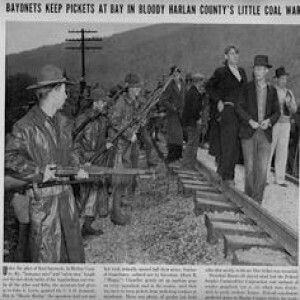
That was the day Sheriff Theodore Middleton and his deputies in Harlan County shot into the house of UMWA organizer Marshall Musick, killing his 15 year-old son, Bennett.
Musick organized for UMWA’s District 19.
He traveled all over Harlan County. As a district organizer, he was beaten, arrested, and evicted from company housing repeatedly.
Some of the mines were organized in Harlan County but barely.
Many coal operators controlled area sheriff departments and restricted daily life of miners and their union representatives.
Organizing drives started in January 1937.
Union men faced extreme physical violence.
Organizers were tear gassed in early January.
Their cars were dynamited later that month.
Musick and his wife were shot at and warned repeatedly to leave town.
Another organizer had his door busted down by deputies and his house ransacked.
Musick finally agreed to leave town to keep his family safe.
When he arrived in Pineville on February 9, he learned his son had been killed in a firestorm of bullets shot into his house.
On March 22, the LaFollette Committee on Civil Liberties opened hearings into Bloody Harlan.
It lasted for six weeks.
The high court drama appeared every day in the Courier Journal.
The Justice Department indicted 69 Harlan County Coal Operators and law officers for criminal conspiracy to violate the Wagner Act.
Meanwhile, the new National Labor Relations Board answered UMWA charges and found in the union’s favor.
The Board issued a cease and desist order against interference with union activity and ordered the reinstatement of 60 coal miners.
Union membership soared to 9000.
The UMWA would continue for decades to fight to keep Harlan County organized.
Saturday Feb 10, 2024
Saturday Feb 10, 2024
On this day in labor history, the year was 1919.
That was the day copper miners in Butte, Montana went on strike.
Mine owners announced a $1 a day wage cut when copper prices slumped in financial markets.
Swayed by the power of the Seattle General Strike then in progress, miners associated with the IWW and the Metal Mine Workers Union, Local 800 formed their own Soldiers’, Sailors’, and Workers’ Council.
They issued a call for a general strike.
For days, area trade unionists honored picket lines, left their jobs and held meetings to debate joining a general strike.
The streetcar workers shut down public transportation for five days.
Soldiers returning from the war helped man picket lines.
The labor paper, Butte Daily Bulletinreported the post-war economy left returning war heroes penniless and working in dangerous mines.
While solidarity was unanimous among workers, their unions had yet to pass formal resolutions.
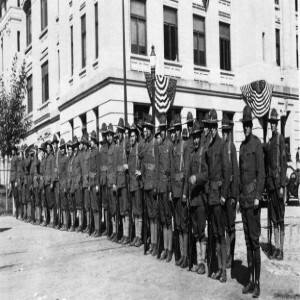
Immediately, Montana’s governor, Sam V. Stewart, called in the 44th Infantry to crush the strike. Infantrymen bayoneted nine strikers, when they tried to stop the anti-labor Butte Daily Post from being distributed.
Spirits were high by the end of the first week as official voting began.
The streetcar men went back to work, citing no grievances with their employer.
Then the engineers followed. Finally the IBEW caved.
They worried the engineers would take their jobs, as they had done in a 1917 strike.
The IWW and local 800 called off the strike, fearing continuation would be fatal.
Though most of the troops were soon withdrawn, one company stayed to ensure labor peace at the local water and electric works.
Butte would remain under federal military occupation until the end of 1920.