
A daily, pocket-sized history of America's working people, brought to you by The Rick Smith Show team.
Episodes
Sunday Apr 07, 2024
Sunday Apr 07, 2024
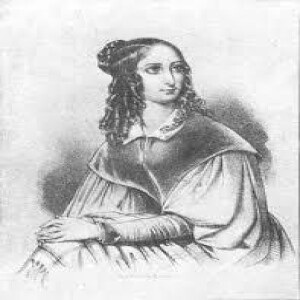
On this day in labor history, the year was 1803.
That was the day Utopian Socialist and women’s rights activist Flora Tristan was born.
She is also remembered as the grandmother of painter, Paul Gauguin. Mario Vargas Llosa most recently popularized her life in the 2003 novel, The Way to Paradise.
Her family was aristocratic but she grew up in poverty outside Paris.
The young Flora found work in an engraving shop and married the shop artisan, Andre Chazal.
Together they had three children.
When the marriage became violent, she left him, though divorce was impossible.
By some accounts, she became a maid for the wealthy and traveled Europe.
It was through her travels that she became a socialist.
She witnessed abject poverty and inequality in too many countries and was drawn to the works of the Utopian Socialists.
Tristan campaigned for the right of divorce and wrote at length of workers struggles on the cusp of industrialization.
Her novels, which confronted women’s inequality and workers rights, appeared in the late 1830s.
She regularly visited feminist and socialist salons in Paris where ideas linking social transformation and women’s rights were popular.
Her most well known work of non-fiction is The Workers’ Union, which appeared in 1843.
In it, Tristan argues that craft guilds could no longer adequately represent workers in an era of industrialization.
She envisioned an international union of workers that organized regardless of skill level, a union that took on broader issues of social justice.
Tristan also tied the advancement of women to the advancement of workers.
She believed that discrimination against women only strengthened anti-worker forces.
Workers and women had to take up each other’s causes in order to win true justice.
Saturday Apr 06, 2024
Saturday Apr 06, 2024
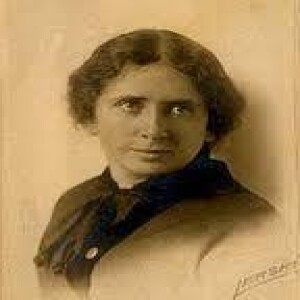
On this day in labor history, the year was 1882.
That was the day trade union leader and suffragist Rose Schneiderman was born.
She arrived from Poland and settled in New York City with her family as a child.
Her father died soon after, and Rose entered the workforce at the age of 13.
She sewed caps and organized with the United Cloth and Cap Makers.
Rose became a chief organizer with the New York Women’s Trade Union League and played a prominent role in the 1909 Uprising of the 20,000.
While touring Ohio to rally support for women’s suffrage in 1912, Schneiderman said “What the woman who labors wants is the right to live, not simply exist–the right to life as the rich woman has the right to life, and the sun and music and art.
You have nothing that the humblest worker has not a right to have also. The worker must have bread, but she must have roses, too.”
She grew frustrated with the privileged middle class women of the New York WTUL and began organizing with ILGWU.
But she soon quit, aggravated by the leadership’s indifference toward organizing women workers.
Schneiderman devoted her energies to women’s suffrage.
She would soon return to the WTUL.
By 1926, she served as its national president and became close friends with Eleanor Roosevelt.
President Roosevelt appointed her to the National Advisory Board where she wrote NRA codes for industries with women workers.
Labor historian Annelise Orleck noted “Schneiderman attacked sexual segregation in the workplace, tried to unionize women… called for state regulation of working conditions… She argued for comparable worth laws, government-funded childcare, and maternity insurance... Those ideas and dreams are the legacy of Rose Schneiderman.”
Friday Apr 05, 2024
Friday Apr 05, 2024
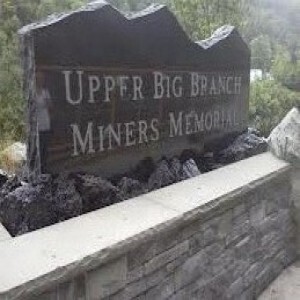
Today marks the anniversary of the Upper Big Branch disaster.
This is the second of two parts commemorating that moment in labor history in 2010.
Accumulation of explosive methane gas was so pronounced that the mine had to be evacuated several times leading up to the disaster.
A 126 page Governor’s Independent Investigation Panel report detailed the systemic failures of safety systems and at governmental agencies to enforce regulations. Lack of proper ventilation, adherence to rock dusting standards and proper maintenance of machinery were main factors.
The panel also held MSHA responsible for “disregarding the documented risk of methane outbursts at the mine, overlooking the deadly potential of a precarious ventilation system, neglecting to use its regulatory authority to force technological improvements, and allowing the U.S. mine safety system to atrophy.”
They determined MSHA could have issued flagrant violation citations and had the authority to shut the mines down, but didn’t. The report noted the cozy relations between mine owners, politicians, judges and regulators, specifically “the ease with which state mine officials move from employment with industry to government and back.”
Despised union-busting CEO Don Blankenship, who was tried and convicted to one year in jail, insisted his mines were safe. He cited three Sentinels of Safety awards received from MSHA in 2009. These awards went to surface mining and coal processing plant operations.
The company consistently contested violations and attempted to control the state’s political system in order to defeat oversight agencies. Blankenship even blamed MSHA for the explosion because the agency demanded changes in UBB’s ventilation system.
A union safety committee could have shut down the mine before methane gas and coal dust combined to cause the explosion. If only there had been a union.
Thursday Apr 04, 2024
Thursday Apr 04, 2024
Tomorrow marks the anniversary of the Upper Big Branch mine disaster.
This is the first of two parts commemorating that moment in labor history.
The year was 2010.
A massive explosion ripped through Massey Energy’s mine in Raleigh County, West Virginia.
The explosion killed 29 miners.
It was the deadliest in decades.
The explosion at UBB revealed the ruthlessness of profit-driven mine executives
Raking in $104 million in profits the year before, they callously insisted the explosion had been an act of God.
The explosion also exposed the immense pressures on federal and state regulators to look the other way or go easy on enforcement.
And it demonstrated just how deep the ties go between industry, regulators and those in seats of political power.
The UBB mine explosion served as a testament to the increasingly unsafe and non-union nature of the industry.
35 years ago, 95% of the state’s mines were union.
Walkouts over health and safety were common.
Now, less than 25% are, and workers risk their livelihoods if they dare to speak up about safety.
As well, over 70% of those autopsied from UBB were found to have black lung disease, entirely preventable with proper ventilation.
Massey executives routinely violated safety rules as a cost of doing business.
American University’s detailed study of Massey’s safety record for the years 2000-2010 concluded that no other U.S. coal company had a worse fatality record.
A total of 54 workers, including those at UBB had been killed during that time period.
They also found that Massey had been cited for 62,923 violations including 25,612 considered ‘significant and substantial.’
At the time, MSHA had proposed close to $50 million in fines.
Wednesday Apr 03, 2024
Wednesday Apr 03, 2024
On this day in labor history, the year was 1937.
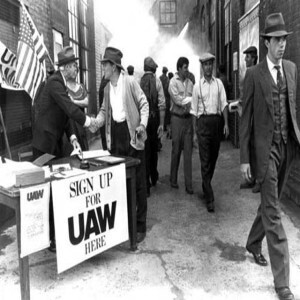
That was the day over 1000 autoworkers at the Ford assembly plant in Kansas City, Missouri began their occupation.
The sit-down was the first strike by the UAW against Ford. UAW president, Homer Martin vowed to organize the entire company.
The strike had been called the previous evening, when workers learned 350 of their coworkers had been laid off at the end of the day shift.
They demanded reinstatement, higher wages, better working conditions and recognition of the union.
Workers spent a good part of the early morning hours welding the gates shut to the railroad yards and parking lots surrounding the plant.
Then, they selected an 18-man committee to direct the strike.
One leader, O.W. Penney stated: “… When the company forced the strike on us by unfairly laying off men because of union membership (some with 12 years on the job), everybody joined up with us.
We signed 200 outside the plant and they’re signing others inside.” Penney added, “The pay here is not as good as at either Chevrolet or Chrysler plants… The boys there have better sanitary facilities and a cafeteria, while we have to eat our lunches sitting on the floor.”
Strikers lowered a banner from the top floor of the plant that read, “Lincoln Freed the Slaves. Ford Brought Them Back.”
Ford insisted he would never allow his plants to be organized.
But company representatives spent the weekend negotiating a settlement with the UAW to rescind the layoffs.
By Monday, April 5 workers were back on the line.
Strike authorizations would flare up just two weeks later when Penney and another UAW organizer were beaten at the hands of company thugs.
Tuesday Apr 02, 2024
Tuesday Apr 02, 2024
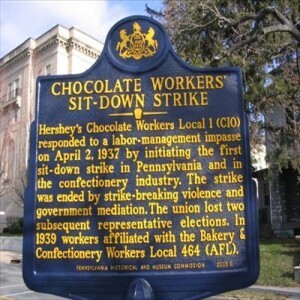
That was the day workers sat down at the Hershey chocolate plant in Hershey, Pennsylvania.
CIO organizers for the new United Chocolate Workers Union reported that anywhere from 2000-2400 workers were on strike.
Hershey was a company town, where streets were named Chocolate and Cocoa Avenue.
Housing was built for workers and the company funded public education and transit service.
But the company also sought to monitor and control workers behavior on their off-time and showed favoritism in hiring and wages.
The Great Depression created dire conditions even in Candy Land. Hours and bonuses had been cut.
Workers grew increasingly frustrated with production speed-up and unpredictable work schedules.
All while Hershey still drew handsome profits.
The company initially raised wages after meeting with the union but then laid off organizers three months later.
That’s when workers shut off their machines and occupied the plant.
The company refused to negotiate unless workers left.
By April 7, dairy farmers became incensed at the loss of income.
They mobilized with anti-union company forces to storm the factory and drive the strikers out.
Organizers had agreed to end the strike in order to resume negotiations and avert violence.
But the anti-union forces attacked the sit-downers with bats, whips, clubs and hammers.
Three CIO organizers were singled out and severely beaten.
Governor George Earle condemned the attack and blamed the County Sheriff for suppressing labor rather than preventing mob rule.
The strike was smashed. Attempts at installing a company union failed soon after.
Hershey’s would be one of the first candy companies to be organized when the Bakery, Confectionary, Tobacco Workers and Grain Millers International Union won recognition two years later.
Monday Apr 01, 2024
Monday Apr 01, 2024
On this day in labor history, the year was 1946.
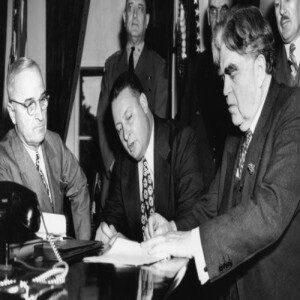
That was the day 400,000 bituminous coal miners walked off the job in 26 states.
They demanded higher wages, better health benefits and safety regulations.
The strike began to cripple industrial operations nationwide.
By May 22, President Truman seized the mines. Miners returned to work a week later.
John L. Lewis, president of the United Mine Workers, signed an agreement with Secretary of the Interior, Julius Krug.
It included $wage increases and vacation pay, the five day workweek and contributions to a retirement fund.
The strike led to “The Promise of 1946,” otherwise known as the Krug-Lewis Agreement.
It created the UMWA Health and Retirement Funds.
It is this fund that is often referred to in present day discussion concerning the loss of retiree health and pension benefits.
According to Robert Hartley and David Kenney, authors of Death Underground: The Centralia and West Frankfort Mine Disasters, “the welfare program was to provide medical care, rehabilitation treatment and death benefits.
It provided the authority for the Director of the U.S. Bureau of Mines to establish a Federal Mine Safety Code… to enforce mine safety regulations and provided the first legal authority for federal inspectors to close mines found to be dangerous.”
Lack of enforcement would prove deadly for miners in Centralia and West Frankfort. The Health and Welfare Funds, however, provided relief and security for miners for decades.
But in recent years, many companies have gone out of business and found legal loopholes to shed their retirement responsibilities.
Those miners affected are today fighting for the passage of the Miners Protection Act, which would provide access and funding to shore up the pension plan.
Sunday Mar 31, 2024
Sunday Mar 31, 2024
On this day in labor history, the year was 1969.
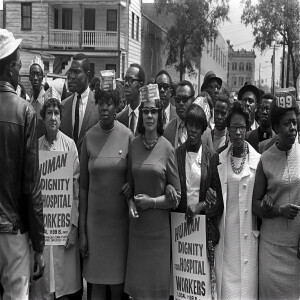
That was the day Dr. Ralph Abernathy, president of the Southern Christian Leadership Conference arrived in Charleston, South Carolina to address striking hospital workers and their supporters.
More than 400 black hospital workers at Medical College Hospital and Charleston County Hospital had walked off the job earlier in the month.
They demanded an end to racial harassment and discrimination, wage increases, union recognition and reinstatement of fired coworkers.
It was yet another instance where workers’ struggles embodied the broader social debates of the day.
Struggles for racial and gender equality as well as the rights of public sector workers to organize, especially in the South all converged in Charleston.
Workers at both hospitals sought out Local 1199, which had already organized hospital workers in New York City.
Local 1199B was soon chartered and Mary Moultrie, a licensed nurse from Medical College Hospital was elected president.
Twelve workers were fired when the new union demanded recognition.
That’s when they voted to go on strike. Picketers were met with injunctions and arrests.
The president of MCH, William McCord stated he would not “turn a 25 million dollar complex over to a bunch of people who don’t have a grammar school education.”
He and Governor, Robert McNair cited the state’s right to work law as justification for refusal to recognize the union.
The SCLC arrived in Charleston to lend its support. Speaking to 1500 workers and their supporters Abernathy linked the struggles of Local 1199B to those of meat packers and sanitation workers.
He also charged that Congress would rather spend millions on war than to “stand people on their feet in Charleston.”
Saturday Mar 30, 2024
Saturday Mar 30, 2024
On this day in labor history the year was 1870.
That was the day the Fifteenth Amendment was adopted into the United States Constitution.
It was the third of the Reconstruction amendments.
It prohibited voting restrictions on the basis of race, color or previous condition of servitude.
Premier historian Eric Foner states that the Reconstruction Amendments reflected “a newly empowered national state and the idea of a national citizenry enjoying equality before the law.
These legal changes also arose from the militant demands for equal rights from the former slaves themselves.”
The bulk of Southern states refused to ratify but then capitulated. Interestingly, New York sought and failed to revoke its early ratification.
The amendment split the women’s suffrage movement for its failure to codify women’s voting rights.
Some Radical Republicans also abstained on the basis that it did not also prohibit poll taxes or literacy tests. Immediately, the 15th amendment came under attack.
The Ku Klux Klan terrorized black voters and Reconstruction governments for years.
One of the most extreme examples was the 1873 Colfax massacre.
After the Compromise of 1877, President Rutherford B. Hayes refused to enforce civil rights protections.
The rise of discriminatory Jim Crow laws effectively disenfranchised Southern blacks for nearly a century.
Congress would finally enforce the 15th amendment fully through the landmark Voting Rights Act of 1965.
However, the Act has come under attack most recently, as in the 2013 case, Shelby County v. Holder.
Jurisdictions with histories of voter restrictions no longer have to obtain preclearance before implementing changes to voting laws and practices.
Over 150 years after the end of the Civil War, African-Americans are still fighting to protect their right to vote.
Friday Mar 29, 2024
Friday Mar 29, 2024
On this day in labor history, the year was 1937.
That was the day the U.S. Supreme Court issued its ruling on the case, West Coast Hotel v. Parrish.
The ruling upheld a Progressive-era Washington state law that established minimum wages for women.
An example of protective legislation, it intended to guard the health, safety and morals of women workers.
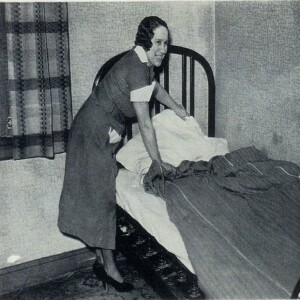
Elsie Parrish had been a chambermaid at the Cascadian Hotel in Wenatchee, Washington until 1935.
She sued and won at the State level after she was paid far below the minimum wage.
The parent company, West Coast Hotel, appealed to the Supreme Court.
They argued the Progressive-era law violated the constitutional right of individuals to freely contract with one another.
This interpretation was common during the Court’s Lochner era.
The 1905 Lochner v. New York ruling against maximum hours for bakers ushered in a period of anti-labor Supreme Court rulings.
Parrish is considered the landmark case that brought an end to that era.
The Court argued that the Constitution does not speak of freedom of contract and added “the exploitation of a class of workers who are in an unequal position with respect to bargaining power… is not only detrimental to their health and wellbeing, but casts a direct burden for their support upon the community.
What these workers lose in wages, the taxpayers are called upon to pay.”
The case is also considered instrumental in “the switch in time that saved nine.”
It was a reference to Justice Owen Roberts’ surprising shift in favor of Parrish. This occurred just as President Roosevelt finalized plans to increase the number of Supreme Court justices to 15.
Though Parrish did not overturn Lochner, it did mark a period of pro-labor rulings.