
A daily, pocket-sized history of America's working people, brought to you by The Rick Smith Show team.
Episodes
Sunday May 05, 2024
Sunday May 05, 2024
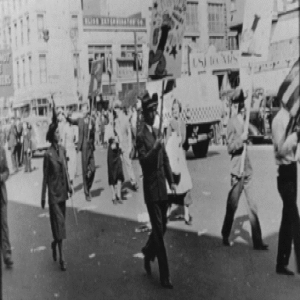
On this day in labor history, the year was 1937. That was the day animators struck Fleischer Studio in New York City. It was the industry’s first strike.
Creators of Popeye the Sailor Man and Betty Boop were fed up with working conditions at Fleischer. They were sick of long hours, low pay, no paid sick leave or even vacation time. Some had worked years without a day off. As well, they resented having to ask permission to use the bathroom.
Animation workers wanted better working conditions and medical insurance. Two animators had recently died of tuberculosis and workers linked their deaths to poor ventilation in the studio. They had been trying to organize with the Commercial Artists and Designers Union for over a year.
Two leading animators were fired for union activity a month earlier and another 13 were fired when CADU approached the studio demanding their reinstatement, union recognition, wage increases and benefits.
In his book, Drawing the Line, Tom Sito writes that picketers were soon marching on Broadway, singing, “We’re Popeye the Union Man, We’ll Fight to the Finish, Because We Can’t Live on Spinach.”
One picket sign read, “I make millions laugh but the real joke is my salary.” Strikers received support from the Screen Actors Guild. The musicians union refused to provide soundtracks for the studio and many union projectionists refused to show Fleischer cartoons across the country.
The AFL organized a boycott of Paramount Pictures, which financed the studio and area longshoremen frequently joined picket lines.
After five months, the studio finally caved, granting strikers demands. But the victory was short-lived. Fleischer made moves to relocate to Florida within a year, in part to bust the union.
Sunday May 05, 2024
Sunday May 05, 2024
On this day in labor history, the year was 1935.
That was the day President Franklin Roosevelt issued Executive Order 7034, establishing the Works Progress Administration.
The WPA employed millions in public works projects during the Great Depression.
As many as 8.5 million Americans worked for the WPA at some point, between the years 1935 and 1943.
At its height, over 3 million Americans were working WPA jobs.
These jobs included the construction of roads, bridges, utilities and parks.
It also meant the construction of new schools, libraries, public buildings and housing.
Many WPA jobs also employed musicians, artists and writers in literacy and art projects.
The program’s goals were to provide one job to every household suffering long-term unemployment.
Some of the most famous projects include LaGuardia Airport in New York City, Blue Ridge Parkway and Great Smokey Mountain National Park.
Artists like Jacob Lawrence and Mark Rothko were employed at the Federal Arts Project.
Historian Erik Loomis notes that the Federal Writers Project began the field of oral history with extensive interviews of surviving ex-slaves.
The Household Service Demonstration Project trained tens of thousands of women for domestic employment.
The WPA also bolstered federal funding for school lunches.
The program was initially criticized for underemployment of African-Americans, who suffered disproportionately during the Depression.
But many black leaders later hailed the WPA as providing job opportunities to blacks and keeping race discrimination to a minimum, at least in the North.
The Right attacked the program as a hotbed for Communists and a scheme to build Democratic Party patronage.
By 1940, WPA projects shifted toward war preparation and defense-related projects.
When the country reached full employment in 1942, the WPA ceased to exist by July of 1943.
Sunday May 05, 2024
Sunday May 05, 2024
On this day in labor history, the year was 1886.
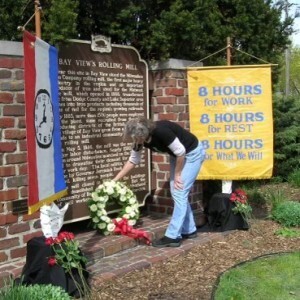
That was the day Wisconsin State Militia shot down workers striking for the eight-hour day in Milwaukee, killing seven.
It is known as the Bay View Massacre.
As cities across America erupted into strikes for the eight-hour day, municipal workers in Milwaukee had already won shorter working hours.
Many private employers had followed suit.
The Central Labor Union and the Knights of Labor mobilized thousands in the campaign to bring the rest of the city’s employers into line.
Building tradesmen joined Polish, German and Native American laborers in strikes and marches across the city for nearly a week
They marched to area factories, calling out to workers to join the strike.
By May 3, every factory in town was shut down except for the Milwaukee Iron Company Rolling Mill in Bay View.
Workers marched to the mills and demanded workers join them.
At this point, Governor Rusk called out the militia.
They formed a line just inside the gates to prevent strikers from reaching mill workers.
As the events of Haymarket unfolded in Chicago that evening, area businessmen became increasingly fearful of upheaval brewing in the city.
Governor Rusk gave the ‘shoot to kill’ orders should any striker attempt to enter the mills.
The next morning, as 1500 strikers marched towards the mill, they were fired upon by the militia.
Seven were killed, many more injured.
Strikes for the eight-hour day ended abruptly.
Many union leaders were indicted and Polish workers were practically blacklisted from working in the city for their radicalism.
Though the massacre shattered hopes for the eight-hour day, Milwaukeeans responded by electing Populists and Socialists in local and regional elections for years to come.
Sunday Apr 28, 2024
Sunday Apr 28, 2024
On this day in labor history, the year was 1948.
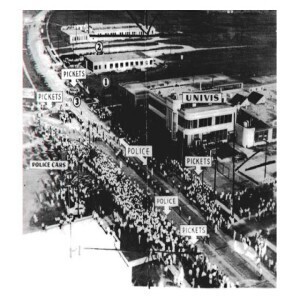
That was the day United Electrical workers voted to strike at Univis Lens Company in Dayton, Ohio.
Univis made safety lenses and instrumental optics.
The UE was well established in area manufacturing plants.
Once organized, Univis fought the UE’s presence every chance they could.
When the contract expired at the end of April, Univis refused to negotiate.
First came the injunction limiting picketing.
This was followed by a vigorous decertification campaign
Foremen made intimidating, personal visits to workers’ homes, offering raises and personal loans to coerce ‘no’ votes.
When the UE lost the election in late July, the company announced wage increases for returning workers and firings for remaining strikers.
Workers stuck together and the strike continued.
By the 26th, police swarmed the picket lines, beating top UE organizers and arresting hundreds.
Two days later, the company offered a settlement for all but 11 strikers.
The members refused.
Then House Un-American Activities Committee came to town to begin a red baiting inquisition of the UE district.
The city’s unions were outraged at the beatings and arrests.
They walked off their jobs to bolster the picket lines and were met with tear gas.
Governor Herbert called in the National Guard on August 2.
1500 troops rolled into town in Sherman tanks with machine guns trained on the strikers.
Scabs were escorted through plant gates between rows of fixed bayonets.
Area residents, furious at the virtual martial law established, flooded the governor with angry protests until troops were finally withdrawn.
The strike ended in victory, with workers winning most of their demands.
All but five were reinstated and by the following April, the NLRB voided the decertification election.
Sunday Apr 28, 2024
Sunday Apr 28, 2024
On this day in labor history, the year was 1911.
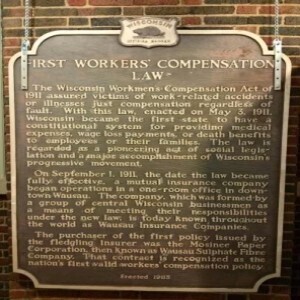
That was the day the State of Wisconsin passed the Wisconsin Workmen’s Compensation Act.
The state became the first to “have a constitutional system for providing medical expenses, wage loss payments or death benefits to employees or their families.
The law is regarded as a pioneering act of social legislation and a major accomplishment of Wisconsin’s Progressive movement.”
Activist journalism exposed deadly and disfiguring working conditions in the country’s industries.
State industrial commissions were established to conduct factory inspections and demand reform legislation and regulations.
Upton Sinclair’s initial intent in writing The Jungle was to cultivate a public outcry for better and safer working conditions.
By 1907, the Russell Sage Foundation funded dozens of investigators to study industrial and social conditions in Pittsburgh, Pennsylvania.
Two volumes of essays were produced, entitled The Pittsburgh District: Civic Frontage and Wage-Earning Pittsburgh.
The essay, Work-Accidents and the Law, written by Crystal Eastman, exposed the enormity of work-related accidents and deaths, and the failure of employers to compensate victims and their families.
Her investigation examined several industries, including railroads, steel and coal mining.
She noted, “There is no bright side to this situation. By Industrial accidents, Allegheny County loses more than 500 workmen every year of whom nearly half are American born, 70 percent are workmen of skill and training and 60 percent have not yet reached the prime of their working life. Youth, skill, strength, in a word, human power, is what we are losing.”
Eastman’s survey worked to shift the burden from workers to employers.
It is largely credited with the passage of workers compensation laws, though it would take decades for similar laws to be enacted in states throughout the country.
Sunday Apr 28, 2024
Sunday Apr 28, 2024
On this day in labor history, the year was 1968.
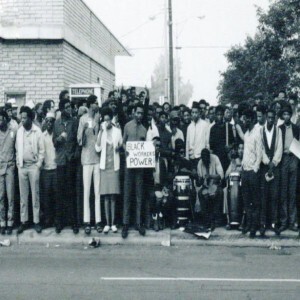
That was the day 4000 autoworkers at Chrysler’s Dodge Main plant in Hamtramck, Michigan walked out in a wildcat strike.
They protested assembly line speed-up but also racist foremen and the firings of seven coworkers.
The strike was significant for many reasons.
It injected Black Power politics within the union movement.
The CIO had made unprecedented gains in the 30s and 40s through interracial organizing and combating Jim Crow on the job.
However, racial discrimination persisted in industries across America.
The wildcat shocked the UAW leadership, having prided itself on its early and central involvement in the Civil Rights Movement.
By 1968, many African-Americans grew frustrated with the slow pace of reform and found the militancy of the Black Power movement attractive.
According to historian Robert Weir, black autoworker activists considered many UAW officials “paternalistic, condescending and out of touch with changing urban realities.”
Many of their white coworkers joined them on the picket lines.
Black activists at Dodge Main condemned the UAW for failing to address the disproportionate racial discrimination they faced on the job.
They demanded a separate contract that spoke to the needs of black workers and the right to bargain directly with the company.
The wildcat immediately grew into the Dodge Revolutionary Union Movement and inspired similar groupings at area auto plants.
Those white workers who were initially sympathetic, worried that DRUM demands would serve to weaken and ultimately split the union movement along racial lines.
DRUM would continue to demand safer working conditions, shorter hours and higher wages, an end to the Vietnam War and more black union officials and supervisors.
The movement was short-lived but continues to be revered among Detroit activists today.
Sunday Apr 28, 2024
Sunday Apr 28, 2024
On this day in labor history, the year was 1919.
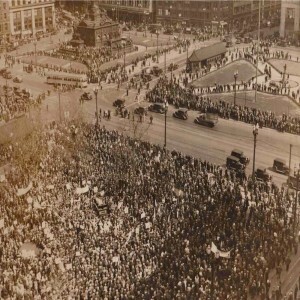
That was the day May Day celebrators in Cleveland, Ohio were attacked as they marched to protest the imprisonment of Socialist, Eugene V. Debs.
1919 was a year of massive upheaval, marked by countless strikes and protests, riots and bomb threats.
But much of the country was still caught up in the jingoism of the war.
Debs had just entered prison to serve a ten-year sentence.
He had been convicted in Cleveland of sedition for an anti-war speech he gave in Canton, Ohio the year before.
Thousands of trade unionists, anarchists, socialists and communists marched towards Public Square in downtown Cleveland.
Prominent Socialist Charles Ruthenberg led one of the contingents.
He planned to address the rally in defense of Debs and also to promote his candidacy in the upcoming mayoral elections.
May Day marchers carried Red flags and American flags, and banners reading “Workers of the World, Unite.”
Liberty Loan workers stopped them en route, demanding they lower their flags.
Marchers refused and attempted to proceed towards downtown.
Fighting broke out in the streets and lasted for hours until mounted police and army tanks charged the crowd.
Two were killed, at least 40 seriously injured and as many as 120 were arrested.
Ruthenberg was charged with “assault with intent to kill,” though charges were later dismissed.
Socialist Party headquarters were ransacked.
The city immediately moved to restrict parades and socialist meetings, and banned red flags.
Local newspapers were quick to scapegoat immigrants and their supposed Bolshevik sympathies for the riot.
The attack in Cleveland served as an early warning of the Red Scare that would fully erupt by the end of the year.
Sunday Apr 28, 2024
Sunday Apr 28, 2024
On this day in labor history, the year was 1952.
That was the day 100,000 oil refinery workers went on strike.
The work stoppage was called by a coalition of 22 unions, including AFL and CIO affiliates and independent unions.
They demanded a 25-cent hourly wage increase with shift differentials.
Shutdowns began at once and picket lines went up as soon as procedures were safely completed.
The strike threatened to cut production in half.
Union leaders called all but California refinery workers out, who were central to the war effort in Korea.
Oil barons had given refinery workers the run around for eight months during contract negotiations.
The union had even postponed the original strike date in March to give Federal Mediation a chance at effecting a settlement.
When this failed, President Truman brought the case to the Wage Stabilization Board, which issued a ruling favorable to the industry.
Eighty companies demanded separate hearings for all 200 bargaining units involved.
The union wanted one hearing for all.
Even after this victory for the oil companies, they then refused to attend the hearings!
When the Board threw up its hands in mid-April, the new strike deadline was set.
Eight days into the strike, the Board ordered oil workers back to work, which they flat out refused.
The Oil Workers Union stated “Strikers are fighting against a stacked deck… if corporation executives are permitted to ignore workers needs, then to manipulate the government so the right to strike is denied, collective bargaining will be destroyed.”
The Board then set a 15-cent an hour wage cap and shift differentials. Workers were back on the job by the end of the month, having avoided possible Taft-Hartley actions from President Truman.

Sunday Apr 28, 2024
Sunday Apr 28, 2024
On this day in labor history, the year was 1946.
That was the day 8,000 UAW workers at the Allis-Chalmers plant in Milwaukee voted overwhelmingly to walk off the job.
Close to 12,000 production and maintenance workers were on strike across the country.
Workers rode the post-war strike wave as whole industries moved to peacetime reconversion.
Historian Eric Fure-Slocum notes that UAW Local 248 had a historically militant left-wing leadership, was known for its support to housing desegregation campaigns in the city and was a central driving force of Milwaukee’s CIO Council.
They had built a strong shop steward and grievance structure at Allis-Chalmers and were sure victory was certain.
Local president Robert Buse insisted wage increases were not at issue but rather unresolved issues remained to be settled, now that the war was finally over.
Key points of contention were the company’s demand to eliminate maintenance of membership agreements that guaranteed the closed shop and union dues.
The company also wanted to stop paying stewards for time involved in grievance procedures.
The Allis-Chalmers strike was a harbinger of things to come.
Historian Martin Halpern states that company officials played a significant role in the crafting of Taft-Hartley legislation as the strike unfolded.
Allis-Chalmers was on a union-busting campaign and made no small effort to redbait union leaders for months in local newspapers.
By the fall, workers at the smaller plants had returned to work, but the Milwaukee local stood firm.
Area CIO workers joined picket lines in support only to be brutalized and arrested.
HUAC arrived in town to investigate the strike and the company instigated a vigorous back-to-work campaign.
After eleven months, the strike was called off with no contract and ninety-one union leaders were fired.
Sunday Apr 28, 2024
Sunday Apr 28, 2024
On this day in labor history the year was 1971. That was the day the Occupational Safety and Health Act went into effect.
At the time, it was estimated that 14,000 workers died annually on the job, 2.2 million workers were permanently or temporarily disabled and half a million developed occupational diseases each year.
It was estimated that at least 25 million serious injuries and deaths went unreported each year.
Many of the standards, regulations and enforcements OSHA now has, have come as a result of intense, continuous pressure waged by the labor movement.
The Oil, Chemical and Atomic Workers Union (OCAW) was the first to test out the new bill when they filed a complaint against Allied Chemical in Moundsville, West Virginia in May 1971.
Among the many hazards at the facility, pools of mercury on the shop floor were common occurrences.
OSHA issued its first citation against Allied Chemical under the General Duty clause.
The first OSHA standard issued came a year later, for asbestos.
Today, the AFL-CIO notes that for the year 2015, 4,836 workers were killed on the job, there is one OSHA inspector for every 76,000 workers and on average it would take OSHA 145 years to inspect every workplace once.
But new rules protecting workers from silica dust and beryllium have been established, as have strong reporting and recordkeeping standards.
There are stricter coal dust standards and anti-retaliation protections for workplace whistleblowers. The Trump administration is looking to overturn all of it.
You can take action this Workers Memorial Day to protect working conditions on the job.
Find an event in your area by going to: https://aflcio.org/issues/workplace-health-and-safety