
A daily, pocket-sized history of America's working people, brought to you by The Rick Smith Show team.
Episodes
Sunday May 12, 2024
Sunday May 12, 2024
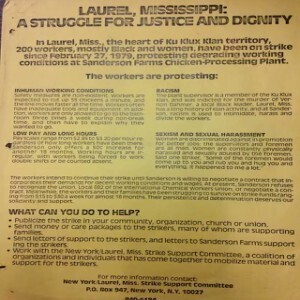
On this day in labor history, the year was 1980.
That was the day 4000 strikers and their supporters gathered for the March for Dignity and Respect in Laurel, Mississippi.
Over 200 mostly black women members of International Chemical Workers Union Local 882 had been on strike against Sanderson Farms chicken processing plant for 15 months.
Trade unionists from as far away as Cincinnati, Memphis and North Carolina came to march in support.
Sanderson Farms had cleared $58 million in profits but paid workers just $3 an hour.
The women demanded a contract that included more control over assembly line speed, overtime pay, and insurance.
They complained of desperately low wages, inhumane working conditions, and even the inability to use the bathroom when necessary!
Workers were given only gloves and an apron once a month, and a file to sharpen their often dull and rusty scissors and knives.
They often referred to the processing plant as the plantation, where sexual harassment was rampant.
Women workers often found themselves given dangerous assignments or even fired if they didn’t put up with sexual advances of their foremen.
Workers maintained that strikebreakers from the community were desperately poor and threatened with violence if they quit, by local Ku Klux Klansmen who worked as supervisors at the plant.
Some were known as having been involved in the murder and/or intimidation of civil rights workers in decades past.
The plant had been organized in 1972, but was extraordinarily weak.
Nonetheless, women strikers understood that the union still served as an invaluable resource in the midst of a largely unorganized South.
By the following February, the NLRB ruled that Sanderson had to resume contract negotiations and allow strikers to return to their jobs.
Sunday May 12, 2024
Sunday May 12, 2024
On this day in labor history, the year was 1934.
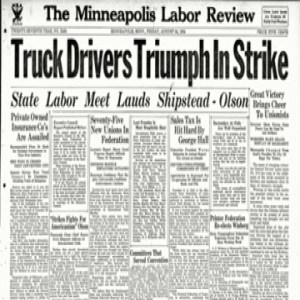
That was the day Minneapolis Teamsters walked off the job.
It was an historic strike that coincided with the pivotal Toledo Auto-Lite and West Coast Waterfront strikes.
Local Teamsters, many of whom later founded the Socialist Workers Party, had been riding a wave of success, having organized the coal yards in February.
Especially important was the development of the ‘Cruising Picket Squad.’
It became a standard in later CIO battles.
That spring, union leaders were determined to organize all the truck drivers and warehouse workers in Minneapolis.
By May, Local 574 had over 5000 members.
The trucking bosses refused to deal with the union and so they walked.
The flying pickets toured the city and shut down all trucking.
Strikers enlisted the support of the unemployed councils.
They also provided the structure for a Women’s Auxiliary that produced important strike literature and bulletins, ran soup kitchens that fed thousands of strikers daily, fought scabs and police on the picket lines and drove picket trucks.
Historian Bryan Palmer, author of Revolutionary Teamsters: The Minneapolis Truckers’ Strikes of 1934,notes that strike leaders looked to the example of Illinois’ Progressive Miners of America when it came to building the women’s auxiliary.
They too sought to make women an integral part of the strike, thus “encroaching on the male world of waged work.”
Strike headquarters were established and as Palmer describes, was a beehive of activity on the eve of the strike “as union carpenters and plumbers installed stoves, sinks and serving counters. Union electricians installed communications wiring.”
Donations of money, food, vehicles, and gas rolled in as the strike revved up.
Local 574 was poised to make Minneapolis a union town.
Sunday May 12, 2024
Sunday May 12, 2024
On this day in labor history, the year was 1919.
That was the day the Winnipeg Trades and Labour Council called a general strike.
It is considered one of the most important strikes in Canadian history.
Social tensions intensified as soldiers returned home in search of work, only to find skyrocketing unemployment and inflation.
In Winnipeg, building trades and metal workers attempted to organize and bargain as an umbrella organization.
They walked off the job at the beginning of May, appealing to the city’s unions for support.
On this day in 1919, some 30,000 workers walked off the job, starting with women telephone operators.
The general strike had begun.
Union and non-union workers alike heeded the call.
Factories shut down.
Public services came to a halt, including transit, mail service and utilities.
Having lost most of their workers to the strike, newspapers quickly branded strikers as Bolsheviks, depicting them as bomb throwers in cartoons.
Winnipeg’s bosses formed the Citizens Committee of 1000 and declared the general strike a conspiracy led by “alien scum.”
When the police sided with strikers, they were fired and replaced in their entirety by ‘Specials,’ used to break the strike.
Workers were intransigent and by the middle of June, the federal government ordered the arrest of strike leaders.
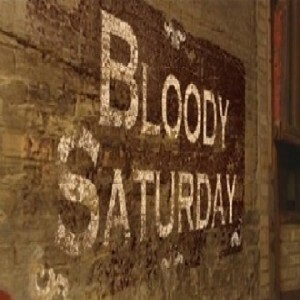
When tens of thousands of workers gathered on June 21 for a demonstration at Market Square, they were charged at by Royal Mounted Police, armed with clubs and guns.
Two strikers were killed and scores more were injured in what is known as Bloody Saturday.
Winnipeg was under military occupation and the strike ended in heavy losses for workers.
But many strike leaders won regional political elections the following year, defeating the very forces that smashed their strike.
Sunday May 12, 2024
Sunday May 12, 2024
On this day in labor history, the year was 1913.
That was the day Philadelphia longshoremen walked off the job.
Led by the Industrial Workers of the World, the strike was remarkable for its militancy, its industrial unionism and its interracial organizing.
The Wobblies had been fighting to organize workers in the city for years.
Unionizing efforts included amalgamated local 57, which organized workers across whole industries.
Attracted to the IWW’s message of interracial unionism, black longshoreman Ben Fletcher joined up readily and soon emerged as an early leader of local 57 and then longshoremen’s local 8.
In his book Wobblies on the Waterfront,historian Peter Cole notes the origins of the local started with striking sugar-refinery workers on the banks of the Delaware.
Dockers made contact with the IWW during the strike and drew up a list of grievances and demands.
By May 14, 1500 longshoreman struck for a leveling of the hourly wage for all workers regardless of skill, shorter hours and union recognition.
They held strike meetings every day and elected a committee of 15 with representatives from every ethnic and racial group.
Cole notes this was crucial, given the diversity of the docks’ 4000 workers.
More than a third were black, another third were immigrant.
The committee included Poles, Jews, Blacks, Irish and others.
Strikers took on their employers and also the police. Beatings, intimidation and arrests of strikers occurred daily and intensified as the ship owners attempted to herd in scabs.
1200 coal and iron ore handlers joined in the strike.
The port was solidly shut down and by the end of the month the shippers were forced to concede to most of the Wobblies’ demands. Industrial unionism and interracial solidarity won the day.
Sunday May 12, 2024
Sunday May 12, 2024
On this day in labor history, the year was 1975.
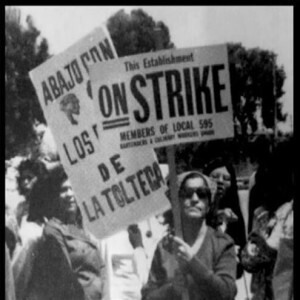
That was the day workers at Tolteca Foods in Richmond, California went on strike.
Many were undocumented Mexican women who helped organize the plant in 1969.
In his book, The Revolutionary Imaginations of Greater Mexico, historian Alan Eladio Gomez states that the women had grown increasingly frustrated with the lack of union response regarding “speed-ups, immigration raids, discretionary firings, substandard wages and unsafe working conditions and began to look elsewhere for support.”
They reached out to the organization CASA, which provided legal and social services for undocumented immigrants.
The women decided to strike without authorization form the Contra Costa Labor Council.
They packed the council’s emergency meeting, where they put their scarred bodies on display to attest to the dangerous and abusive working conditions and poor wages.
Just as the council sanctioned the strike, workers learned the company started removing machinery from the factory.
They packed the picket lines to stop the trucks from taking out the equipment.
The first driver stopped, the second plowed through several women.
The strike committee won an injunction to prevent removal of equipment and after three weeks, workers won their demands.
Gomez argues the strike was important for several reasons.
It demonstrated that a largely female and undocumented workforce could organize and win a strike against a transnational company, at a moment when unions were increasingly under attack.
They maintained a rank-and-file independence that built support for their demands from their union leaders and the broader community.
The women workers at La Tolteca fought for bread and butter issues.
They also worked to reshape their union to take on broader issues of social justice that included immigration rights and women’s rights.
Sunday May 12, 2024
Sunday May 12, 2024
On this day in labor history, the year was 2008.
That was the day Immigration and Customs Enforcement agents besieged the Agriprocessors meatpacking plant in Postville, Iowa.
At the time, it was the largest immigration raid in U.S. history.
Nearly 400 workers, mostly from Guatemala and Mexico were rounded up, detained and arrested on charges of identity fraud and entering the United States illegally.
The raid was part of a nationwide campaign targeting suspected undocumented workers.
The raid essentially killed two birds with one stone.
It quashed the union organizing campaign the UFCW had been waging for over two years.
It also dashed the hopes of Department of Labor investigators looking into allegations of substantial abuses at the plant.
UFCW leaders noted the raid served to eliminate hundreds of witnesses to labor violations at the plant.
The raid did uncover at least 29 cases of child labor violations, with children as young as 13 working on the killing floor.
But Minneapolis UFCW organizers maintained that company agents routinely followed UFCW reps on home visits and threatened workers they spoke with.
They noted that “wages are extraordinarily low, basic worker safety and protection is miserable.
It’s intensified by the fact that this employer was able to come up with a more vulnerable workforce and abuse it over the long haul.”
These workers were quickly convicted, jailed and then deported.
They were soon replaced by a fresh wave of Somali refugees, who complained of the same low wages and poor working conditions.
The company was eventually fined for countless violations and its CEO arrested. It emerged from bankruptcy under new ownership and has yet to be organized.
Sunday May 05, 2024
Sunday May 05, 2024
On this day in labor history, the year was 1967.
That was the day the United Farm Workers’ Sons of Zapata joined with the Confederation of Mexican Workers in establishing an international picket line across the Rio Grande Valley.
A push to organize farm workers at six major growers began the year before, in the spring of 1966. Wages in Starr County ranged from 40-85 cents an hour.
Farm workers began their strike in June 1966 for wage increases and union recognition.
But growers would rather see their crops rot than recognize the union.
They did grant wage increases but immediately ran to the courts for injunctions.
One district judge outlawed all picketing, while police instructed county workers to spray strikers with insecticide.
That August, workers voted to organize with the United Farm Workers and began a pilgrimage march to the state capitol to popularize their cause.
15,000 workers and their supporters reached Austin on Labor Day to demand their right to organize.
They returned to Starr County to continue their strike.
The growers turned to Mexican commuters holding green cards to break the strike.
The UFW began picketing at the Roma and Rio Grande City bridges and were often successful in turning back green card workers.
By May 1967, melon harvest had begun.
After months of negotiations with the CTM, picket lines went up on both sides of the international bridges.
The picketing was 100% successful for two days.
But the Mexican government and Starr County Sheriff’s department soon intervened to break up the picket lines.
Texas Rangers were brought in to arrest and brutalize strikers.
The strike was broken but organizing continued throughout the region.
Picketing across borders was itself an important act of international solidarity.

Sunday May 05, 2024
Sunday May 05, 2024
On this day in labor history, the year was 2005.
That was the day United Airlines got the OK to ditch its pension obligations in federal bankruptcy court.
Workers were dragged through years of employee ownership schemes, massive layoffs and concessions, and the gambling away of hard-earned pensions on the stock market.
Then in 2002, United filed bankruptcy.
Many asked, how could this happen at an airline owned by its workers?
By 2005, creditors like Citigroup and J.P. Morgan were fully in control. ‘Employee ownership’ had meant trading billions of dollars in deep wage cuts and givebacks for stock ownership and a couple of seats on the board.
‘Controlling interest’ meant a six-year no-strike pledge, the slashing of tens of thousands of jobs and massive outsourcing.
By 2005 the stock was worthless.
Then United moved to weasel out of union contracts just 24 hours after the court ruled on the pension default!
Some 130,000 pilots, flight attendants, mechanics and ground service workers found their employee stock ownership plans empty.
United executives turned billions over to the federal government who then administered what was left through the Pension Benefit Guaranty Corporation.
In most cases, those pensions were slashed in half and monthly retiree health insurance costs exploded by 700%.
One pilot stated: “I call it legalized crime. I lost almost all my United stock value in the bankruptcy, and here’s another part of the retirement I was promised that is gone. Where does it all end? You feel brutalized by the system.”
Somehow, the $6 million in benefits then CEO Glenn Tilton received, wasn’t affected by the default.
Now that United is swimming in hundreds of millions in profits, many retirees have demanded the restoration of their original pension plans.
Sunday May 05, 2024
Sunday May 05, 2024
On this day in labor history, the year was 1934.
That was the day the West Coast Maritime strike began.
It was an historic strike that shut down the major ports along the Pacific coast.
The strike also coincided with the pivotal Minneapolis Teamsters Strike and Toledo Auto-Lite Strike.
From Seattle to San Diego, longshoreman walked off the job.
Harry Bridges led the Albion Hall caucus in San Francisco.
They demanded higher wages, shorter hours and union representation.
They also demanded a coast-wide agreement and a union hiring hall to replace the hated daily ‘shapeup.’
Longshoremen were fed up with the gangster-run, company union that controlled the arbitrary, day labor hiring on the docks.
From the pages of the Waterfront Worker newsletter, militant longshoremen took on the shippers, the government, craft unionism and racism of the union.
On the first day of the strike, dozens of black longshoremen joined the union and convinced others not to scab.
Soon all unions on the docks walked out in solidarity.
By May 15 all west coast ports were completely shut down and 25,000 were out on strike by the end of the month.
In his book, Workers on the Waterfront, Bruce Nelson notes the qualities that made the strike a success.
He points to the militancy and discipline required to stand up to the National Guard during the deadly, main battle of July 5, the workers solidarity across craft lines necessary for the San Francisco general strike that followed, a defiant rank-and-file independence, and the understanding that intensive red-baiting could only serve the bosses.
Though workers were forced back to work through arbitration, they were awarded their demands that fall.
It would take more job actions to make those awards a reality.
Sunday May 05, 2024
Sunday May 05, 2024
On this day in labor history, the year was 1877.
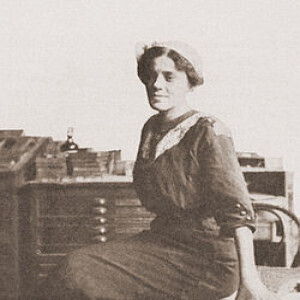
That was the day American socialist Mary Marcy was born.
Raised in Belleville, Illinois, Mary moved to Kansas City and joined the Socialist Party.
She found work as a secretary to meatpacking executives at Swift and then Armour.
Her 1904 investigative series, “Letters of a Pork-Packing Stenographer,” published in the International Socialist Review, revealed the inner workings of the “Big Five” trust.
Marcy described how the packinghouse bosses manipulated markets, set rates and prices, and created an industrial monopoly.
She also exposed low wages and dangerous working conditions in the industry.
Months later, she provided testimony and secret correspondence of executives to a Grand Jury investigation.
The case made a big splash in the press, though packers would win immunity from prosecution a year later.
Mary lost her job and hired on with the Associated Charities of Kansas City.
There she became critical of philanthropic forces that lectured the poor on morals rather than provide concrete aid.
She serialized her experiences in the fictional account, Out of the Dump.Returning to Chicago, Mary worked as assistant editor to the International Socialist Review.
Her wildly popular book, Shop Talks on Economics, served as a primer on socialism.
She continued to agitate against World War I, publishing articles like “You Have No Country!”
Mary threw her lot in with the IWW in 1918, though the split in the Socialist movement soon after affected her deeply.
She and her husband lost their home after mortgaging it to provide bail for numerous Wobblies, including Bill Haywood, then swept up in Red Scare conspiracy trials.
The period proved too much for her and in 1922 she took her own life.