
A daily, pocket-sized history of America's working people, brought to you by The Rick Smith Show team.
Episodes

Sunday May 26, 2024
Sunday May 26, 2024
On this day in labor history, the year was 1937.
That was the day the Steel Workers Organizing Committee or SWOC, called a nationwide strike against three of the four ‘Little Steel’ companies, Republic, Inland and Youngstown Sheet & Tube.
The drive to organize Little Steel came on the heels of an historic agreement with U.S. Steel and J&L earlier in the year.
In his book, The Last Great Strike, legal scholar Ahmed White points out that SWOC leaders established a three-pronged strategy in their organizing efforts: to breakdown racial and ethnic differences among workers, to use the Wagner Act and newly formed NLRB to their advantage whenever possible and to take over company unions where they existed.
They hoped Little Steel would follow earlier precedent.
But mill owners wouldn’t budge on union recognition.
Firing of organizers intensified and lockouts began.
Sheriffs departments began the swearing in of deputies.
Republic and Youngstown Sheet & Tube started shipping and stockpiling munitions, including machine guns and tear gas to mills throughout the Midwest and Northeast. Scattered walkouts and wildcats began throughout the latter part of May as SWOC continued to demand recognition and first contracts.
And on this day SWOC delegates from the Little Steel locals met in a Youngstown ‘war council’ to demand a strike.
The strike began late that evening with the shift change at 11 pm.
The mills were shut down tight.
Pitched battles between strikers, scabs and police continued throughout the summer with hundreds arrested.
Anti-union violence would explode with the Memorial Day Massacre in South Chicago and the Women’s Massacre in Youngstown the following month.
After five months, the strike collapsed. It would take until 1942 before recognition was finally won.
Sunday May 19, 2024
Sunday May 19, 2024
On this day in labor history, the year was 1934.
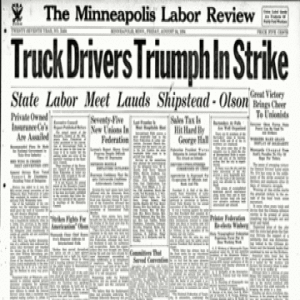
That was the day trucking bosses and leading Teamsters in Minneapolis reached a tentative agreement after a tumultuous week of fighting in the City Market.
Strikers won many of their demands, including union recognition and reinstatement of all strikers.
Such thorough victory at the Battle of Deputies Run earlier in the week had shaken city elites to the core.
As the dust settled on the picket lines, Governor Floyd Olsen had called a 24-hour truce in an effort to organize negotiations.
The debacle of Ohio National Guardsmen attacking Toledo strikers had reached Minneapolis.
Fears of a growing ‘Red Menace’ fueled demands for a settlement, prompting Olsen to order National Guardsmen into the city’s armories, armed to the teeth.
Historian Bryan Palmer, author of Revolutionary Teamsters: The Minneapolis Truckers Strikes of 1934, observed that the May 25 deal settled the strike quickly enough, but final victory would be postponed.
Strike leaders had to choose which concessions to make under immense pressure from state politicians, intractable employers and federal mediators.
They also worked to avoid a potentially deadly confrontation with the National Guard.
Above all, they demanded union recognition, agreed to arbitration of future disputes and withdrew the demand for a closed shop.
There was no contract and the inclusion of inside workers proved contentious.
Palmer adds the gains were limited but real enough, as strike leaders spelled out: What had begun as a violent assault on strikers ended with workers fighting in their own interests, learning they had only their union to rely on.
The open shop offensive was defeated and union recognition was won. In the weeks ahead, it would become clear the fight was far from over.
Sunday May 19, 2024
Sunday May 19, 2024
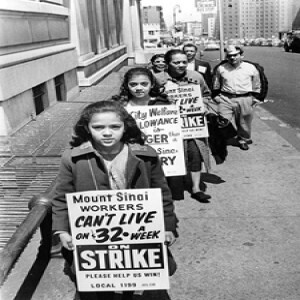
On this day in labor history, the year was 1959. That was the day Operation Humanity marched in support of New York City hospital workers fighting for union recognition and bargaining rights at area voluntary hospitals.
Workers organizing with Local 1199 had been on strike since May 8 and called on the public to support them in their efforts. They pointed out that the 30,000 overwhelmingly black and Latino workers were fighting against economic exploitation and discrimination.
Striking workers condemned their paltry wages, which averaged $21 less a week than workers at city hospitals. They added they had no job security or benefits and were not even eligible for unemployment. The Central Labor Council, the NAACP and area civil rights activists all supported the march.
In their book, Upheaval in the Quiet Zone, Leon Fink and Brian Greenberg noted that “a union largely led by Jews had squared off against hospitals directed by the scions of the city’s Jewish Community…to the degree that it was a ‘family affair,’ the 1959 fight thus took on the bitterness of a civil war.”
As well, Catholic trade union leaders decried the anti-union fervor of the hospitals run by the Archdiocese. Fink and Greenberg illustrate the support of fiery Mike Quill, president of TWU local 100, who denounced hospital trustees as worse than famed segregationist Governor Orval Faubus of Arkansas.
Weeks into the strike, area trade unions supplied reinforcements in the form of donations, loans and groceries. Local IBEW members assessed themselves $1 a week for the strikers. Many unions regularly joined picket lines in support.
Though the strike would fail to secure union recognition and collective bargaining rights, there were minimal gains. Solidarity galvanized the membership for future battles.
Sunday May 19, 2024
Sunday May 19, 2024
On this day in labor history, the year was 1934.
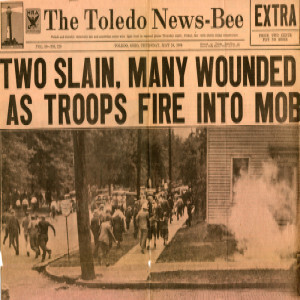
That was the day the Lucas County Sheriff ordered an attack on thousands of Electric Auto-Lite strikers and Unemployed League supporters, touching off the six-day Battle of Toledo.
The Toledo Auto-Lite Strike was one of three historic strikes of 1934 that turned the tide favorably toward industrial organizing.
The Auto-Lite company had granted a wage increase but reneged on promises of a first contract that included seniority rights, a closed shop and more.
Workers walked off the job in mid-April.
As the strike was about to collapse, Unemployed League forces, organized by A.J. Muste’s American Workers Party, joined picket lines in support.
When legal wrangling failed to subdue the strike, scabs and deputized ‘specials’ were amassed.
On this day, the picket lines grew to as many as 10,000.
The deputies began arresting strike leaders and attacking picketers with fire hoses, tear and vomit gas.
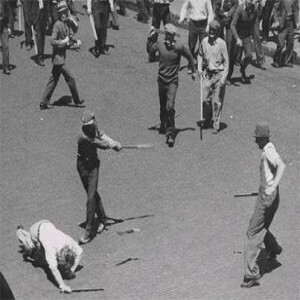
Historian Bryan Palmer describes the scene this way: “Angry workers laid siege to the factory; 1500 strikebreakers were imprisoned.
The scene was one of almost medieval tumult: windows were smashed with stones and bricks, many of them launched from giant slingshots improvised from rubber inner-tubes…When every window in the factory had been smashed, one striker shouted: “now you have your open shop.”…
The next day, 900 Ohio National Guardsmen arrived on the scene… women jeered ‘the landing of the Marines,’ while soap-boxers, many of them veterans sporting First World War medals, offered impromptu lectures on how the troops were breaking the strike…
The strikers’ ranks faced a hail of Guardsmen bullets, which left two dead and scores wounded.”
The battle raged on until the end of May, when it was clear a general strike was imminent.
Sunday May 19, 2024
Sunday May 19, 2024
On this day in labor history, the year was 1934.
That was the day known as the “Battle of Deputies’ Run.”
The Minneapolis Teamsters strike was in full swing.
For three days, the city was peacefully paralyzed.
The wealthiest had kept the city an open shop for decades through their ‘Citizens’ Alliance,’ and now assembled an army of strikebreakers.
Strikers had been seriously injured on Saturday the 19th at the City Market.
They fought police and deputized ‘specials’ in an attempt to keep produce trucks from moving out.
Later that evening, flying pickets were ambushed in Tribune Alley after having been dispatched by an agent provocateur.
Strikers were beaten mercilessly, including several from the women’s auxiliary.
The sight of the bloodied women enraged strikers.
Another fierce confrontation was inevitable.
Hundreds of strikers waited at the Central Labor Union near the Market until Monday, when scab trucks were expected.
Fighting continued throughout the morning.
No trucks moved.
Hundreds of women marched to the mayor’s office demanding, “Take your hired thugs away!”
Anti-union violence so outraged building tradesmen that 35,000 walked off the job in sympathy.
Electricians, painters and ironworkers all reported to strike headquarters.
Then, on this day, that Tuesday, the decisive battle began.
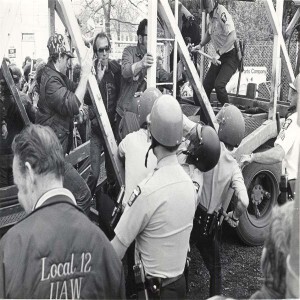
Tens of thousands amassed in the Market on the side of the Teamsters, as ‘deputies’ would attempt to move the produce trucks out.
Strike leader Farrell Dobbs noted, “It became a free-for-all.”
The police stayed back as strikers and deputies battled it out until finally, the deputies dropped their clubs, turned tail and fled.
Union forces cleared the Market of every last scab, cop and deputy.
Historian Bryan Palmer notes, “An intense and deadly confrontation was over in short order. And it left the union in command.”
Sunday May 19, 2024
Sunday May 19, 2024
On this day in labor history, the year was 1984.
That was the day Toledo autoworkers at AP Parts plant battled police in an attempt to save their union.
The battle unfolded on the 50thanniversary of the historic Toledo Auto-Lite Strike.
400 members of UAW local 14 had been on strike against the parts plant since May 2.
The company imposed a final offer that stripped workers of their seniority rights, ended 30 and out pensions, and cut wages by 40%.
Then they laid off 175 workers and targeted the rest with a campaign of harassment and discipline.
Workers walked off the job when the NLRB dismissed the union’s unfair labor practice charges.
Local newspapers printed names and addresses of striking workers in a blatant attempt to blacklist them from area employers.
Strikers had had it with AP’s union-busting tactics, which included paying the hated private goon squad, Nuckols Security, $45,000 a week to escort scabs into the plant.
The final straw came with an injunction, restricting the number of pickets.
In an act of solidarity, area unions came together for a show of union strength.
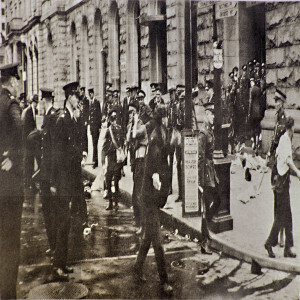
Thousands of UAW people from area auto plants, joined with striking OCAW refinery workers at the main gate, to challenge the new injunction.
Police in full riot gear charged the crowd with tear gas, clubs and pellet guns, beating and arresting dozens of strikers.
A pitched battle ensued between workers and police that lasted up to eighteen hours until the company was finally forced to eject scabs from the plant.
While workers were jubilant, the strike served as a warning about the future of small parts plants.
The strike dragged on for months, ending in deep concessions and outsourcing.
Sunday May 19, 2024
Sunday May 19, 2024
On this day in labor history, the year was 1938.
That was the day unemployed workers began a sit-down strike at the post office in Vancouver, British Columbia.
They had been organized by the Communist–led Relief Project Workers Union during the Depression.
In Canada, federally funded works projects were being administered at the provincial level.
By late 1937 the Prime Minister began to cut funding.
Unable to financially sustain the projects alone, provincial premier Thomas Patullo ended the works projects for British Columbia.
Masses of unemployed men thrown off their jobs, some driven to homelessness, organized occupations of the Hotel Georgia, the Vancouver Art Gallery and the main post office to protest the cuts.
While hotel owners paid protesters to leave, the occupation at the gallery and the post office lasted for weeks.
Finally on Father’s Day, June 18th, gallery occupiers were driven out with tear gas.
The post office strikers were met with much more violence.
Royal Canadian Mounted Police led the assault with tear gas and forcible dragging of sit-downers out of the building.
Once evicted, they were met with the batons of local police.
Organizers were singled out for especially severe beatings and scores were hospitalized for their injuries.
One striker, Arthur Redseth had his eye knocked out while his fellow sit-downer had his jaw broken for asking authorities to call an ambulance for his friend.
Strike leader, Steve Brodie suffered permanent eye damage as well.
News of the terror spread throughout the city and by mid-afternoon 10-15,000 protesters gathered to express outrage at what became known as Bloody Sunday in Vancouver.
Premier Patullo denounced the strikers as having received too much sympathy.
He nonetheless used the debacle as an opportunity to get federal funds reinstated.
Sunday May 19, 2024
Sunday May 19, 2024
On this day in labor history, the year was 1950.
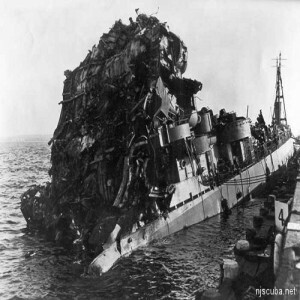
That was the day thirty-one dockworkers were killed and hundreds more injured in an explosion at the Raritan River Port in South Amboy, New Jersey.
Workers were loading ammunition from freight trains onto ships.
The freight’s ultimate destination was Pakistan.
Practically every structure in South Amboy suffered some form of serious or structural damage, with windows blown out everywhere, and debris reported as far as 25 miles away.
5800 more unexploded anti-personnel mines had been strewn about the port.
Demolition experts had to be called in for removal.
A subsequent fire at a nearby agricultural phosphorus plant complicated their work.
The blast was caused by the detonation of 150 tons of military explosives and gelatin dynamite.
The piers, equipment and railroad cars were all demolished, over a dozen nearby barges were either on fire or sank.
Emergency Operations went into effect and a state of emergency was declared.
Key industries in the immediate area were seriously damaged, including the International Smelting and Refining Company, Pennsylvania Railroad maintenance shops and the power plant for Jersey Power and Light.
According to a report by National Board of Fire Underwriters and the Fire Insurance Rating Organization of New Jersey, packing of the mines and fuses by the Kilgore Company was not in accordance with Army standards and labeling was confusing.
The shipped mines were labeled as M1A1 though all parts but the detonator were identical to M1 mines, discontinued by the army in 1942 for their apparent defective fuse, leading to accidental firing and explosions.
Their report refrained from drawing a certain cause or assigning blame.
Instead the underwriters offered a number of possible scenarios and recommendations for best practices to be implemented.
Sunday May 12, 2024
Sunday May 12, 2024
On this day in labor history, the year was 1933.
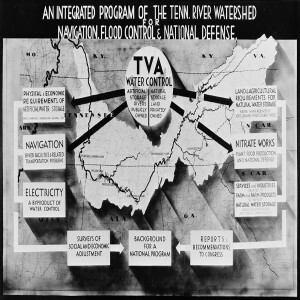
That was the day President Franklin Roosevelt signed the Tennessee Valley Authority Act.
The act created the TVA as a federal corporation and was tasked to address the resource development of the region, one of the poorest in the United States.
These included flood control and improved travel along the Tennessee River.
It also meant improved forestry to address soil erosion and facilitation of agricultural production.
Control of water resources required a series of dams, designed to navigate the river and reduce flooding.
Though Wilson Dam had been completed before the establishment of the TVA, the authority had embarked on the construction of sixteen more dams.
During the Depression, the TVA hired tens of thousands of workers for conservation, construction and development.
Historian Erik Loomis notes that though the TVA was one of the region’s largest employers of black workers, the authority also maintained rigid lines of segregation in its workforce.
He adds that though 14 AFL unions eventually worked on dam construction, the agency initially refused to recognize unions.
Workers would wait until 1940 to sign first contacts in the anti-union South.
Today the authority is most well known for its supply of electricity to nearby communities.
It is the nation’s largest public power company and serves about 80,000 square miles in the southeastern United States.
TVA capacity to generate electric power includes some 29 hydroelectric dams, 11 coal fired plants, 3 nuclear plants and several combustion-turbine installations.
It also has several solar and wind installations.
The authority produces more than 130 billion kilowatt-hours of electricity each year.
The TVA played a critical role in transforming the South by constructing infrastructure necessary for modernization and industrialization.
Sunday May 12, 2024
Sunday May 12, 2024
On this day in labor history, the year was 1980.
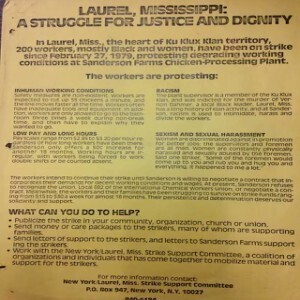
That was the day 4000 strikers and their supporters gathered for the March for Dignity and Respect in Laurel, Mississippi.
Over 200 mostly black women members of International Chemical Workers Union Local 882 had been on strike against Sanderson Farms chicken processing plant for 15 months.
Trade unionists from as far away as Cincinnati, Memphis and North Carolina came to march in support.
Sanderson Farms had cleared $58 million in profits but paid workers just $3 an hour.
The women demanded a contract that included more control over assembly line speed, overtime pay, and insurance.
They complained of desperately low wages, inhumane working conditions, and even the inability to use the bathroom when necessary!
Workers were given only gloves and an apron once a month, and a file to sharpen their often dull and rusty scissors and knives.
They often referred to the processing plant as the plantation, where sexual harassment was rampant.
Women workers often found themselves given dangerous assignments or even fired if they didn’t put up with sexual advances of their foremen.
Workers maintained that strikebreakers from the community were desperately poor and threatened with violence if they quit, by local Ku Klux Klansmen who worked as supervisors at the plant.
Some were known as having been involved in the murder and/or intimidation of civil rights workers in decades past.
The plant had been organized in 1972, but was extraordinarily weak.
Nonetheless, women strikers understood that the union still served as an invaluable resource in the midst of a largely unorganized South.
By the following February, the NLRB ruled that Sanderson had to resume contract negotiations and allow strikers to return to their jobs.