
A daily, pocket-sized history of America's working people, brought to you by The Rick Smith Show team.
Episodes
Friday Aug 02, 2024
Friday Aug 02, 2024
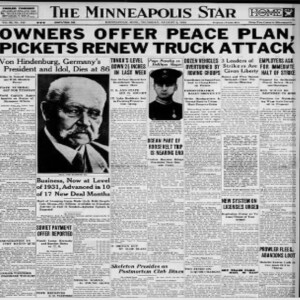
On this day in labor history, the year was 1934.
That was the day striking Teamsters in Minneapolis defied martial law.
They stopped scab trucks, forcing the release of their strike leaders.
Armed with bayonets and machine guns, the National Guard had patrolled the streets for nearly a week.
They seized scores of strikers and union leaders and threw them into military stockades.
Drivers were outraged.
They defied Governor Olson and Major General Walsh who, on behalf of the Citizens Alliance and trucking bosses, were determined to break the strike.
Soon after strikers were imprisoned, drivers began chasing scab trucks across the city.
Multiple reports poured in of pickets forcing trucks to stop.
Some unloaded their cargo onto bridges.
Others chased, captured and damaged trucks.
Strikers ripped ignition wiring out, forced scabs from the wheel and then disappeared before police and the National Guard could arrive to retaliate.
In just three hours, strikers had overturned nearly 70 trucks.
Unable to stop the superior force of striking drivers, Bill Brown, Vincent and Miles Dunne were ordered unconditionally released from the military stockades.
Now employers, the governor, and other strike breaking agencies were eager to propose peace to federal mediators.
But they proposed to scrap the terms of their early May agreement.
In response, the leaders of Local 574 issued a General Strike call.
In it they asked, “Is there one man so blind as not to see that if 574 is allowed to go down to defeat, under the brutal hammering of military despotism, the whole labor movement of the city will have been dealt a mortal blow?
Union men, brothers, sisters, fellow workers!
What are you going to do about it?
We appeal to you for solidarity!”
Thursday Aug 01, 2024
Thursday Aug 01, 2024
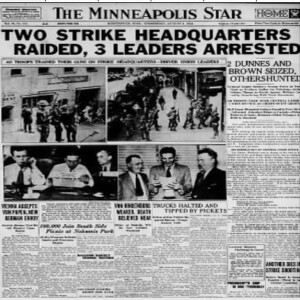
On this day in labor history, the year was 1934.
That was the day National Guard troops in Minneapolis raided Teamsters local 574 headquarters.
Over 150 were arrested, including top strike leaders Bill Brown and the Dunne Brothers, who were imprisoned in military stockades.
Troops also seized union records and files.
Then they raided the Central Labor Union, seizing records and forcing out dozens of area labor leaders.
Teamsters had been battling the trucking bosses and the Citizens Alliance throughout the spring and summer in what would be a turning point for industrial organizing.
Finally, drivers agreed to a tentative settlement on the 25th, but the bosses rejected any deal, refusing to negotiate with ‘Reds.’
Farmer-Labor Party Governor Floyd Olson declared martial law the next day.
4,000 troops arrived, issuing unlimited military permits to scab drivers.
By month’s end, over 7,500 scab trucks were rolling throughout the city!
Local 574 challenged the martial law: they demanded that peaceful picketing and open-air meetings be reinstated; they wanted troops withdrawn from the city; and they wanted all truck movement halted for 48 hours.
When Olson rejected these demands, a mass rally was called for the 31st to mobilize strike support.
25,000 turned out to the Parade Grounds, cheering strike leader Bill Brown, who declared, “the Farmer-Labor Party is the best strikebreaking force our union has ever gone up against!”
Historian Bryan Palmer notes the loudest and longest applause was reserved for Albert Goldman, who thundered, “If we submit without a struggle, then we deserve the fate of submissive slaves. We cannot, we dare not, submit. We call upon the workers, organized and unorganized, to clench their fists, shout defiance of the bosses, and struggle until victory or death.”
Wednesday Jul 31, 2024
Wednesday Jul 31, 2024
On this day in labor history, the year was 1939.
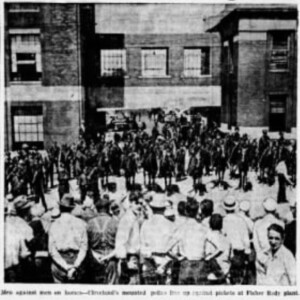
That was the day striking autoworkers in Cleveland, Ohio defended their picket lines in what is known as “The Battle of East 140th Street.”
Members of UAW Local 45 at GM’s Fisher Body plant had been on strike for three weeks.
They had joined striking GM workers at 12 plants throughout Michigan.
They demanded a supplemental agreement granting skilled workers wage increases, overtime adjustments and seniority, and apprentice provisions.
In Cleveland, strikers vowed to stop the scabbing and were mostly successful.
Now, at the start of the morning shift, a scab attempted to plow through picket lines at high speed.
Strikers flooded the gates and brought the scab car to a virtual stop.
As they attempted to convince him not to cross through, mounted police viciously charged and attacked the strikers.
Police continued to shoot tear gas guns from behind plant gates.
Soon, there were more than 5000 picketers fighting with police, as workers poured out from half a dozen nearby plants to support the strikers.
For over two hours, workers showered strikebreaking forces with bricks, rocks and paving blocks.
They overturned scab cars and drove the police off the streets and into the plant.
Fighting broke out again in the afternoon when police tried to bring in more tear gas supplies.
Strike leaders directed activities from an amplifier on the roof of a nearby restaurant.
The next day, famed prohibition crusader, Eliot Ness, now Cleveland’s Director of Public Safety, enforced a 500 yard ”riot zone,” banning all gatherings near the gates and limited picketers to seven at each gate.
Strikers began picketing the homes of known scabs and would ratify a new contract just days later.
Tuesday Jul 30, 2024
Tuesday Jul 30, 2024
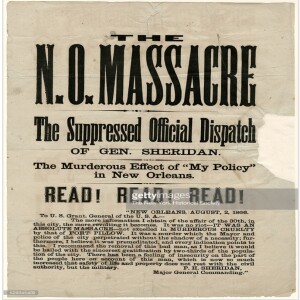
On this day in labor history, the year was 1866. That was the day known as the Mechanics Institute Massacre.
Black and white republicans in New Orleans called a constitutional convention to consider voting rights for African-Americans.
It would be another three and a half years before the ratification of the 15th amendment.
Freedmen, many of them Civil War veterans gathered in the Fauburg-Marigny and proceeded to march to the convention, held at the Mechanics Institute on Canal Street.
Just before they reached the Institute, Black Republicans were confronted by a mob of white democrats, ex-Confederate soldiers and police, determined to prevent blacks from attaining any semblance of civil or political rights.
The delegates were able to momentarily beat back the mob and reach the Mechanics Institute.
But the racist mob charged again and started shooting.
By the time it was over, at least 50, mostly black Republicans were shot dead in the street. More than 200 were seriously injured.
Historian Justin Nystrom notes that it was an absolute massacre.
But he adds it was “actually very useful to the Republican Party because it gave them a concrete example of the kinds of problems former Confederates were causing in the South.”
He adds that events such as these helped influence voters to bring more Radical Republicans into Congress.
These politicians would be key to passing the Reconstruction Acts.
Nystrom points to a poem written by Camille Naudin, to commemorate the one-year anniversary of the massacre.
Titled “Ode to the Martyrs,” the poem mourns the massacred while bitterly observing that Jefferson Davis remains alive: “But for the Mulattos, blacks and whites, this fact I must tell: Victor Lacroix is dead. Jeff Davis lives still.
Monday Jul 29, 2024
Monday Jul 29, 2024
On this day in labor history, the year was 1969.
That was the day AFSCME sanitation workers in Charlotte, North Carolina walked off the job.
More than 85% of the sanitation workers were black in this predominantly white Southern city. It was their third garbage strike in a year.
State statutes prohibited union contracts in municipal agencies.
But AFSCME was determined to win union recognition and establish an agreement with the city.
Southern Director for AFSCME, James Pierce thundered, “We’ll bring in whatever help we can get if the city tries to break the strike.
We can turn this place into a Memphis or a Charleston in a few days.”
Of course, Pierce was referring to two victorious strikes by black workers that had rocked the South within the past year.
Black sanitation workers in Memphis walked out in a historic strike in the spring of 1968.
Hospital workers in Charleston, South Carolina had just won their strike days earlier.
Pierce outlined the issues at stake.
According to the Asheville Citizen-Times, the Charlotte City Council had adopted its final budget without providing dues checkoff, without adhering to established grievance procedures or seniority rights and without adding important safety precautions for garbage collection.
At first, Charlotte’s mayor asserted claims that the strike was about dues checkoff.
But Pierce shot back about broken promises regarding the establishment of safety committees and non-discrimination enforcement.
By the end of the month, a tentative agreement was in place. Strikers won all demands, except the dues check off.
But as hospital workers soon found in Charleston, South Carolina, the city council refused to carry out its agreement with the union.
Sanitation workers in Charlotte would strike twice unsuccessfully over the next year and a half.
Sunday Jul 28, 2024
Sunday Jul 28, 2024
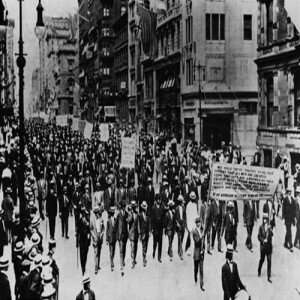
On this day in labor history, the year was 1917. That was the day more than 10,000 African-Americans marched down New York City’s 5th Avenue in what is known as the Silent Parade.
The protest came in the aftermath of the July 2, East St. Louis race riot and a number of lynchings in Texas. Organized by black scholar and activist W.E.B. Du Bois, James Weldon Johnson and the NAACP, the Silent Parade protested lynching and anti-black violence. Children led the march, dressed in white. Women, who were also dressed in white, followed them. Men dressed in dark suits, marched behind.
It was considered the first major public protest of racial violence in the United States. Alexis Newman describes the scene as the parade proceeded to Madison Square. “The marchers carried banners and posters stating their reasons for the march. Both participants and onlookers remarked that this protest was unlike any other seen in the city and the nation. There were no chants, no songs, just silence.” Some signs read, “Mother, Do Lynchers Go To Heaven?” and “Mr. President, Why Not Make America Safe For Democracy?”
Sunday Jul 28, 2024
Sunday Jul 28, 2024
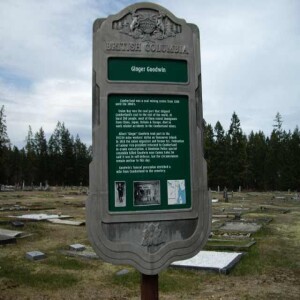
On this day in labor history, the year was 1918. That was the day miner’s president Ginger Goodwin was shot dead in British Columbia. His murder sparked Canada’s first general strike, in Vancouver the following week.
Goodwin had arrived in British Columbia 8 years earlier and found work in the Cumberland Mines on Vancouver Island. He considered working conditions in the mines absolutely appalling and began advocating for safety and organizing miners. He was soon blacklisted after participating in a two-year coal miner’s strike for recognition on the island.
He moved to Trail, British Columbia, where he emerged as a Socialist Party candidate in the 1916 elections. He was also elected president of the International Union of Mine, Mill and Smelter Workers, District 6, the vice-president of British Columbia’s Federation of Labor and the head of the local Trades and Labor Council.
He openly expressed his opposition to Canada’s entry into the war, stating that workers were now employed in killing each other. He was found unfit for military duty after a medical exam. That was, until he led a strike for the eight-hour day at Consolidated Mining & Smelting.
It was the world’s largest lead and zinc smelter and a key munitions producer during the war. His status was quickly changed to make him eligible for conscription. He fled to the Cumberland Hills, where he hid out for months to avoid the draft.
On this day, Goodwin was shot dead by a Dominion Police Special Constable. He was brought back to Cumberland, where thousands turned out for his funeral in a mile long procession. The Vancouver labor movement was outraged by Goodwin’s murder and called a one-day general strike on August 2 to protest his killing.
Friday Jul 26, 2024
Friday Jul 26, 2024
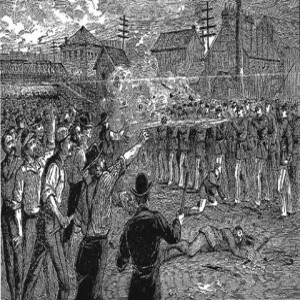
On this day in labor history, the year was 1877.
That was the day striking railroad workers in Chicago clashed with police in the “Battle of the Halsted Street Viaduct.”
The Great Railroad Strike had reached the nation’s railroad hub, and began there three days earlier.
Switchmen from the Michigan Central traveled to freight shops in yards across the city, calling workers out to strike.
Soon lumbershovers, butchers and industrial workers joined the strike.
By the time the Battle began, police had already clashed with unarmed strikers twice. Historian Richard Schneirov describes the scene leading up to the Battle: “The city was now preparing itself for a full-scale insurrection, even though violent confrontations were rooted in police attacks on non-violent crowds.”
Previous confrontations centered in the railroad yards. Now, strikers’ actions spilled over into the neighborhood of Pilsen, where they lived.
Thousands gathered along Halsted Street between 12th and 16th streets.
The police arrived, attempting to disperse the crowd.
They chased strikers south and as Schneirov describes, “emptied their revolvers into the masses of humanity.”
The crowd pelted the police with stones in defense and chased them over the viaduct.
As word spread of the pitched battle, stockyard workers from nearby Bridgeport walked off the job.
They marched along Halsted Street, with butcher knives in hand, to support the strikers under attack.
The crowd on Halsted swelled to more than 10,000 as workers continued to battle police.
By evening, 30 workers had been shot dead, hundreds more were seriously wounded.
But the strike continued to spread more fiercely.
Streetcar stockmen, stonecutters, gas workers, glasscutters and others joined the strike.
The city was shut down for another week until railroad bosses finally rescinded wage cuts.
Thursday Jul 25, 2024
Thursday Jul 25, 2024
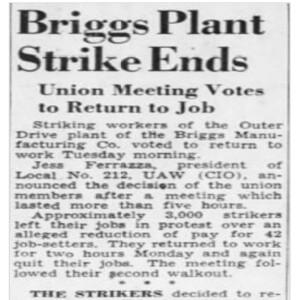
On this day in labor history, the year was 1944. That was the day Local 212, UAW workers at Briggs returned to work.
Briggs was directly involved in war production. 3000 workers, on two shifts, made ball turrets for heavy bombers.
Workers on both shifts walked off the job when management at the Outer Drive plant carried out a series of transfers and layoffs, while expecting the same level of production.
It had been the second walkout in a week. Management set a precedent of refusing to settle grievances of any kind.
They routinely snubbed the union, insisting they take any and all grievances to the War Labor Board.
Local 212 president, Jess Ferrazza noted it would take anywhere from 12-18 months to get a grievance processed.
Workers were fed up with waiting. He added “it was like a fireman with a water bucket running around trying to put fires out.
Management never cooperated.
If the grievance were a justifiable one, they would not settle it.
They would tell you to get the workers back to work.”
The strike came on the heels of a contentious State CIO convention earlier in the month.
There, delegates debated the merits of the no-strike pledge. Local 212 delegates were among a full third of total delegates, who made known their opposition to the pledge. Ferrazza argued that, “the no-strike pledge has tied labor’s hands and as long as our hands are tied, the corporations will continue their attacks on labor.”
Briggs workers agreed to return to their jobs on the promise of direct settlement of grievances.
They also geared up for the national CIO convention, intent on overturning the wartime, no-strike pledge.
Wednesday Jul 24, 2024
Wednesday Jul 24, 2024
On this day in labor history, the year was 1877.
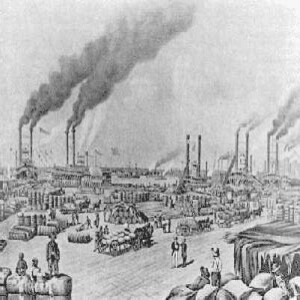
That was the day Louisville sewer workers walked off the job.
The Daily American reported that, “hundreds of black sewer-men stopped work, and began marching through the streets, armed with picks and shovels.”
They went from one sewer construction site to the next, calling workers out to strike for higher wages.
The Great Railroad Strike of 1877 had clearly impacted workers in Mid-Southern cities like Memphis, Nashville and Louisville.
Historian Steven J. Hoffman observes these workers were able to capitalize on strike threats to advance their demands. Railroad bosses for the Louisville, Nashville & Great Southern had rescinded pay cuts for mechanics and engineers.
But they had not raised wages for the lowest paid laborers.
Those laborers joined sewer workers in their march through the city.
By nightfall, the mass of integrated strikers marched to the L&N depot, clashing with police.
Some broke off to march to the Short-Line Depot, smashing windows of the mayor’s house on their way.
Though the crowd was largely dispersed by early morning, Louisville was now in the midst of a general strike.
Hoffman describes the scene: “workers at the metal shops and foundries downtown struck for higher wages.
There were reported strikes at the Kentucky lead and oil works, all the downtown furniture factories, woolen mills, horse collar makers, and tobacco factories as well as by many of the city’s coopers, brick makers and African-American levee workers.
Many of the demands of these workers, which tended to focus on wages and hours, were met and they returned to work quickly.”
Though Southern cites avoided railroad strikes, for the most part, they could not evade the Great Strike’s impact on other sectors of the workforce.