
A daily, pocket-sized history of America's working people, brought to you by The Rick Smith Show team.
Episodes
Thursday Aug 25, 2016
Thursday Aug 25, 2016
On this day in Labor History the year was 1819.
That was the day at Allan Pinkerton was born in Glasgow, Scotland.
His father was a policeman, who died while Allan was a boy.
This left the family in poverty.
As a young man he became involved in the Chartism movement.
This reform movement hoped to expand the political rights of the working class in Great Britain.
Allan had to flee his homeland to avoid arrest because of his involvement.
This led him to Chicago.
It is a great historic irony that Allan Pinkerton came to the United States because of his involvement in a working class cause.
Today Pinkertons are often considered some of the greatest armed foes against unionism in US labor history.
In Chicago, Pinkerton became involved in law enforcement and then formed his own detective agency.
The Pinkerton National Detective Agency made its name working against railway thefts.
But it became most notorious for opposing the labor movement.
Pinkerton spies infiltrated labor meetings for company owners, worked as hired guns to stop union organizing and protected strike breakers.
Pinkerton died in 1884, and passed the agency to his sons.
During the 1890s there were more Pinkertons and reserves than the standing army of the United States.
One of the most famous battles between Pinkertons and workers occurred at the 1892 strike against Carnegie steel in Homestead, Pennsylvania.
There Seven workers and two Pinkertons were killed.
The event inspired a song by William W. Delaney.
The lyrics include the lines, “God help them tonight in their hour of affliction, Praying for him whom they’ll ne’er see again, Hear the poor orphans tell their sad story, “Father was killed by a Pinkerton Man.”
Wednesday Aug 24, 2016
Wednesday Aug 24, 2016
On this day in Labor History the year was 1970.
That was the day that the United Farmworkers went out on strike against California lettuce growers.
The UFW had led a successful boycott against grape growers that had drawn national attention to the harsh working conditions and low pay of those who harvested our nation’s food.
In an effort to keep the UFW from organizing lettuce workers, some of the growers had signed contracts with the Teamsters Union.
The UFW argued that these contracts did not represent the workers’ best interests.
As thousands of workers went on strike, Cesar Chavez called for a national boycott of non-union lettuce.
In the lead-up to the strike an estimated 4,000 workers attended a meeting in Salinas, California.
One worker, Antonio Sagredo explained the importance of the action.
The El Malcriado “Voice of the Farmworker, newsletter reported his words, “Let the people and the government of the United States know that we are ready to work—but that we must have what we ask. It isn’t very much. We don’t ask the impossible—only that they look upon us as human beings. We have the same ambitions that they do. We have families. We have rights. Why must they continue to treat us like beasts of burden and look for a thousand ways to bring us down.”
That December Cesar Chavez was jailed for leading the boycott.
Putting pressure on the growers through encouraging the public to boycott non-union harvested food was a key tactic for the farm worker’s movement.
It impacted the bottom line of the growers and moved them to sit down at the bargaining table.
Tuesday Aug 23, 2016
Tuesday Aug 23, 2016
On this day in Labor History the year was 1900.
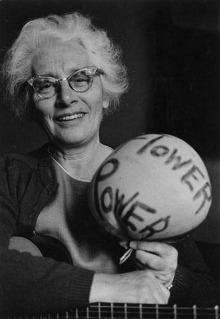
That was the day that folk singer Malvina Reynolds was born to a Jewish family in San Francisco.
Her parents were socialists and operated a tailor shop.
Malvina learned the price of speaking out for what you believe in at a young age.
Her parents opposed US entry into World War I.
Because of this, Malvina’s High School would not issue her a diploma.
She was able to still go the college at Berkley, where she eventually earned her PhD.
She married carpenter and labor organizer William “Bud” Reynolds.
She became a prolific folk singer, playing around the Los Angeles area.
During the 1960s she wrote about songs supporting civil rights and labor rights.
Her song Free Enterprise offers the lyrics, “The air you breathe is poison, the food you eat is worse, the dollars in your pay check are pennies in your purse…There’s nothing free about it, you pay at every turn, Except the guys in Wall Street who have the stuff to burn, they had to make new brain machines to count their profits’ rise, but since there’s always room for more, they can still make their profits soar, a little war does wonders for free enterprise.”
Perhaps her most well-known song is “Little Boxes.”
The song was inspired by driving by hillside houses in Daly City, California.
It talks about the conformity of middle class suburbia.
Monday Aug 22, 2016
Monday Aug 22, 2016
On this day in Labor History the year was 1980.
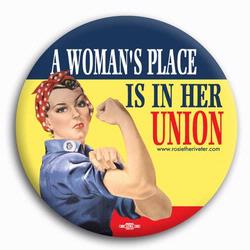
That was the day that Joyce Miller became the first woman ever elected to the Executive Board of the AFL-CIO.
In her 2012 obituary the New York Times described Joyce’s commitment to women’s rights in the labor movement.
Writing “Ms. Miller saw union membership, collective bargaining and labor contracts as the road to equality for working women, and she believed that women should be a part of union management to make sure that attention was paid to issues like equal opportunity, equal pay, parental leave, child care, health insurance and discrimination in the workplace.”
Joyce grew up in Chicago, where she her earned her Master’s Degree in education from the University of Chicago.
She first entered the labor movement as worker at a gumball factory while attending college.
After graduation, she became the Education Director for the Amalgamated Clothing Workers in Pittsburgh.
She remained dedicated to union education for rank and file members.
Joyce was a founding member of the Coalition of Labor Union Women or CLUW.
She served as CLUW’s East Coast Vice President eventually being elected CLUW President in 1977, a position she held for 15 years.
Under her leadership CLUW worked as a powerful voice for women’s reproductive rights, improving child care, and increasing the number of women in union leadership positions.
In 1993, President Bill Clinton named Joyce Miller the Executive Director of the Glass Ceiling Commission.
The purpose of the commission was to gather testimony about women’s experiences in the workplace and to draft a report about their findings.
Of her career Joyce said, “I came to the labor movement with stars in my eyes, I saw it as a vehicle for social change, and I’ve never changed my mind.”
Sunday Aug 21, 2016
Sunday Aug 21, 2016
On this day in Labor History the year was 1893.
That was the day that workers-rights and women’s rights activist and anarchist Emma Goldman gave a speech in New York City.
Emma Goldman was born in what is today Lithuania.
She came to the New York in 1885, where she built a reputation as a powerful speaker.
In New York she addressed a crowd of between 3,000 to 4,000 unemployed workers in Union Square.
The country was at the beginning of a depression that would sweep the nation.
Working families were finding it harder and harder to put food on the table.
By the end of 1893 unemployment would soar to nearly twenty percent.
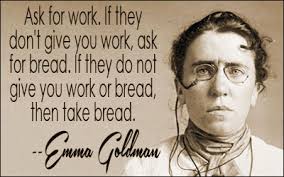
Undercover agents at the rally reported that Emma had urged the crowd to take bread from the capitalists “by force.”
Goldman recounted saying, “Well then, demonstrate before the palaces of the rich, demand work. If they do not give you work, demand bread. If they deny you both, take bread.”
Ten days later Emma was arrested in Philadelphia for her comments at the New York rally.
She was sentenced to a year in prison.
After she was released, Emma traveled to Vienna to study medicine.
She returned to the United States to continue her lectures on workers’ and women’s rights.
She spoke out about the need for women to have access to contraception, an opinion that could arouse a backlash at that time.
Emma was arrested multiple times for daring to speak out on controversial issues.
In 1919, during the height of the Red-Scare anti-communist hysteria, Emma Goldman was deported to the Soviet Union.
Emma was courageous defender of free speech. Often called "the most dangerous woman in America"
Saturday Aug 20, 2016
Saturday Aug 20, 2016
On this day in Labor History the year was 1619.
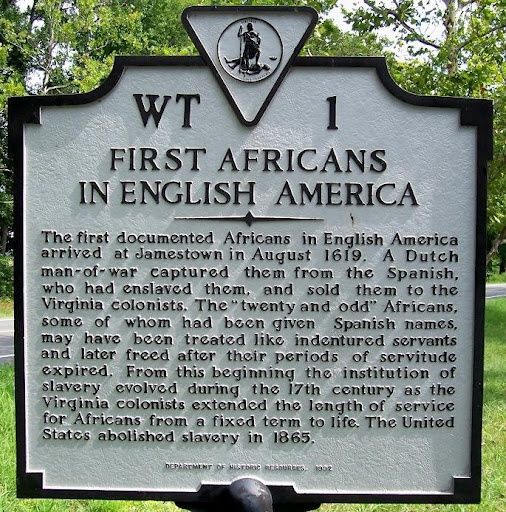
That was the day that the first ship bearing enslaved people arrived in North America.
It was an English warship called the White Lion, that came to Jamestown in the colony of Virginia.
The ship was a privateer and had captured “twenty and odd” enslaved people from a Portuguese ship in a raid.
Virginian planters were interested in forced labor to work the tobacco fields in the colony.
The laws surrounding slavery in Virginia evolved over time.
Throughout the 1600s statutes replacing indentured servants to race-based slavery for life were written into the law books.
In 1654 John Casor became the first person enslaved under rule of law in North America.
By 1662 a law was passed that children would be considered enslaved or free based on the status of their mother in Virginia.
This meant that slavery could pass down from generation to generation.
This and similar laws ensured slavery would grow.
Historians estimate that 388,000 enslaved people came to what became the United States from Africa.
Due to laws passing down slavery to children, by the Civil War there were nearly 4 million enslaved people in the South.
By the early 1800s enslave people made up about one-third of the Southern population.
Initially enslaved labor worked predominantly to produce crops like tobacco, indigo and also rice.
Some West Africans had developed valuable skills in rice cultivation that white land owners exploited through slavery.
With the invention of the cotton gin in 1793, cotton became increasingly important to the southern economy.
The South’s dependence on slave labor became more entrenched, and spread westward with the growing United States until the Civil War ended the brutality of slavery.
Friday Aug 19, 2016
Friday Aug 19, 2016
On this day in Labor History the year was 1997.
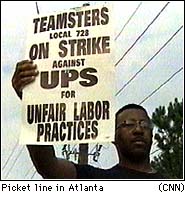
That was the day that a strike by the Teamsters Union against UPS ended with a victory for the union.
The strike had started fifteen days earlier.
More than 180,000 UPS workers participated in the action.
It was the first nationwide strike by UPS workers.
At the time UPS delivered eighty percent of all the packages in the United States.
The company known for its signature brown trucks delivered twelve million packages a day.
The key issue of the strike was that the company increasingly relied on part-time workers.
The insecurities of part time work were growing not just at UPS, but for workers in industries all across the country.
The strike settlement came with the union winning its core issues.
The company agreed to convert 10,000 part-time jobs to full-time positions over the course of the next five years.
The victory was significant for the US labor movement.
The 1980s and 1990s saw new attacks on labor unions and working people, starting with President Ronald Regan’s breaking of the air traffic controllers’ union strike in 1981.
The UPS victory in a national strike with broad rank-and-file support encouraged working people beyond the Teamsters Union.
Announcing the settlement of the strike, ABC news anchor Peter Jennings declared, “It’s been the most dramatic confrontation between industry and organized labor in two decades.”
Teamsters President Ron Carey said, “It is what this country needs, decent jobs, a chance for the dream, a chance to purchase a home, a chance to bring your children up properly, a chance to send them to college. Enough is enough and it’s about time that people start fighting back on this.”

Thursday Aug 18, 2016
Thursday Aug 18, 2016
On this day in Labor History the year was 1949.
That was the day that is remembered as “Kemi Bloody Thursday” in Finland.
Two strikers were killed.
Kemi is a lumber town in northern Finland.
The lumber workers in the area went out on strike when the government proposed slashing their wages by more than thirty percent.
The strike was soon joined by sawmill and dock workers.
The walk out caused a massive log-jam on the Kemijoki River.
On the fateful day 3,000 strikers engaged in a peaceful march.
They encountered armed police, and a confrontation ensued.
The police had guns on their side.
The workers had only rocks and sticks.
One striker was shot and killed.
Another was hit by a truck.
Finnish army troops were called in to Kemi.
Twenty-two strike leaders were arrested.
In response to the violence, sympathy strikes were called by other unions, including the seaman’s union.
These strikes were seen by many as a fight between the Finnish elected government and Communists in the nation’s trade unions.
Officials in the United States worried the strikes were an attempt by Communists to open the door to intervention in Finland by the Soviet Union.
After World War II, Cold War politics shaped responses to labor struggles in many nations.
A song, Fly Black-Winged Bird, remembers the fallen workers.
The lyrics, translated to English, begin, “Fly, black-winged bird, with blood on your feathers across the lands. From village to village carry your message. Open up, Autumn sky for the sad news to spread. Shame on a country where an unarmed man gets shot. Shame on the one who calls the shots.”
Wednesday Aug 17, 2016
Wednesday Aug 17, 2016
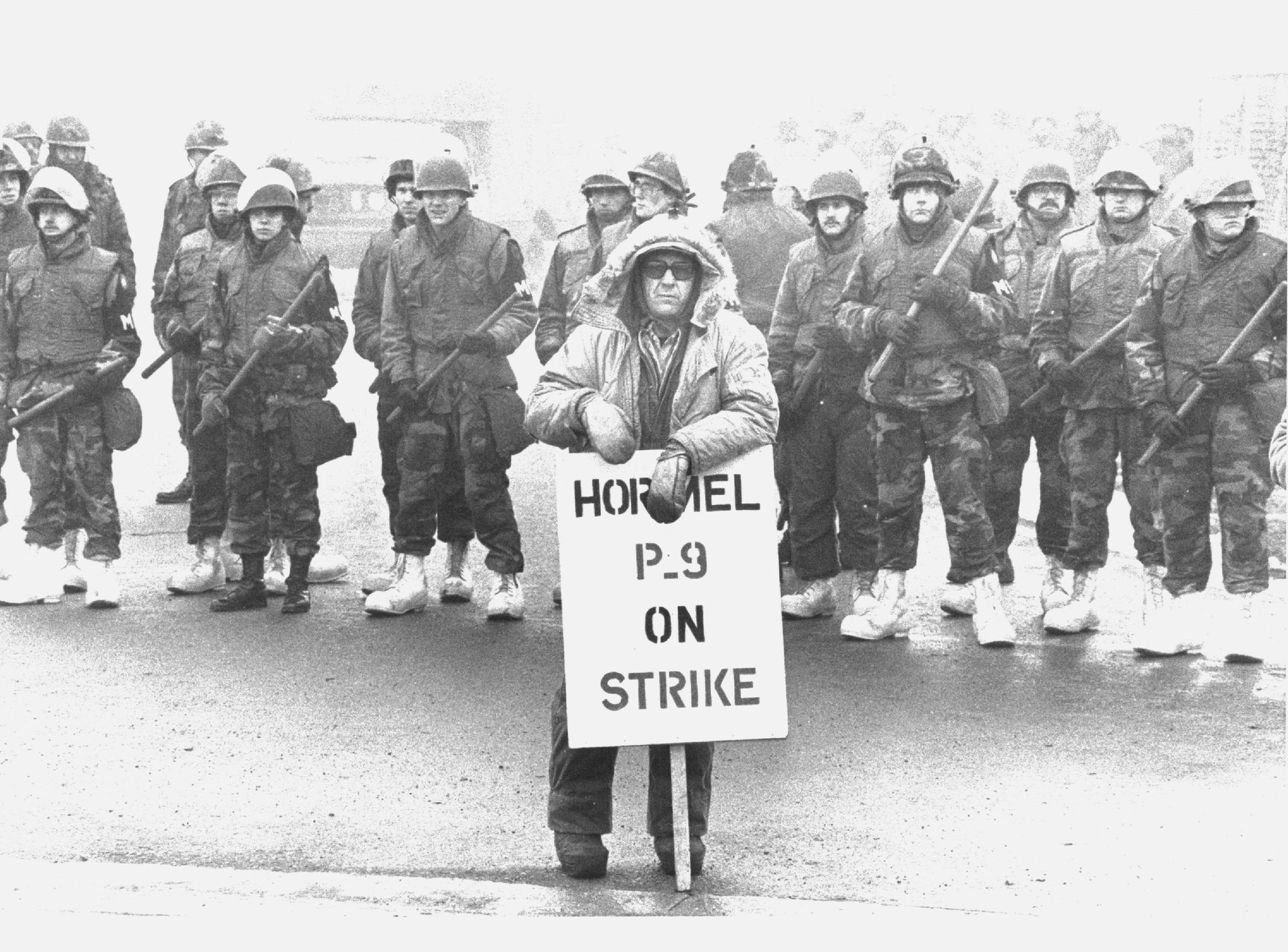
On this day in Labor History the year was 1985.
That was the day that workers at the Hormel plant in Austin,
Minnesota went out on strike.
They were members of the United Food and Commercial Workers
Union Local P-9.
Hormel had slashed workers’ wages by twenty-three percent
during the early 1980s.
Benefits were also diminished and incentive programs rolled
back.
These changes cut deeply into the Hormel workers’ earnings.
What had been considered a good job was changing
drastically.
This was the story for many workers in Regan-Era America.
The 3,500 Hormel workers voted overwhelmingly to
strike.
The national UFCW discouraged the action.
The strike lasted more than a year.
Strikebreakers were brought in, including some of the union
members who crossed the picket line to return to work.
The National Guard was called in to keep the peace between
strikers and scabs.
After a year, the strike went down in defeat.
Even after the strike, many were not called back to
work.
They were put on waiting lists for a job to reopen.
Some never returned to the plant.
Twenty-five years after the strike the Austin Daily Herald staff wrote, “What resulted was a bitter,
drawn-out labor dispute that drastically impacted the community, from workers
who lost jobs to families that were torn apart by picket lines.”
The strike became the feature of a documentary by Barbara
Kopple.
In 1990 the documentary, “American Dream” won the Academy
Award. The
film tells the story of the Hormel strike as a window into
the tragic experiences of many workers in during the 1980s.
The film was made on a shoestring budget.
Singer Bruce Springsteen provided $25,000 to help support
this important film.

Tuesday Aug 16, 2016
Tuesday Aug 16, 2016
On this day in Labor History the year was 1937.
That was the day that the U.S. Congress passed the National Apprenticeship Act.
It was also known as the Fitzgerald Act.
The purpose of the act was “to formulate and promote the furtherance of labor standards necessary to safeguard the welfare of apprentices.”
Apprentices are workers learning a skill set.
They are typically paid less than skilled workers or journeymen during the course of their training.
Apprenticeship programs are especially found in the building trades, where learning skills like plumbing or electrical work might take years of dedicated training.
But before the protection of the 1937 act, there was no national standard governing apprentice programs.
This led some apprentices to be exploited, earning lower wages even after they gained the skills they needed to do the job as journeymen.
In 1911, Wisconsin was the first state to pass legislation to structure the apprentice system.
In the 1920s multiple labor unions advocated for national apprentice standards to promote fairness and safety for workers.
Recognizing the need for national apprentice guidelines, President Franklin Delano Roosevelt commissioned a committee to study the issue.
They were tasked with developing training standards for apprenticeship programs.
The 1937 law gave the committee the authority to complete their job.
The committee on apprentice training became a permanent part of the Department of Labor.
The Bureau of Apprenticeship works with State governments to ensure the fair treatment of apprentices.
Today apprentice programs provide classroom and on-the-job training to help developed a skilled labor force.
In 2015, 52,500 participants graduated from the registered apprentice programs.
Nearly ½ a million workers participated in apprentice training programs, learning skills that will help build their financial security.