
A daily, pocket-sized history of America's working people, brought to you by The Rick Smith Show team.
Episodes
Tuesday Sep 13, 2016
Tuesday Sep 13, 2016
On this day in Labor History the year was 1971.
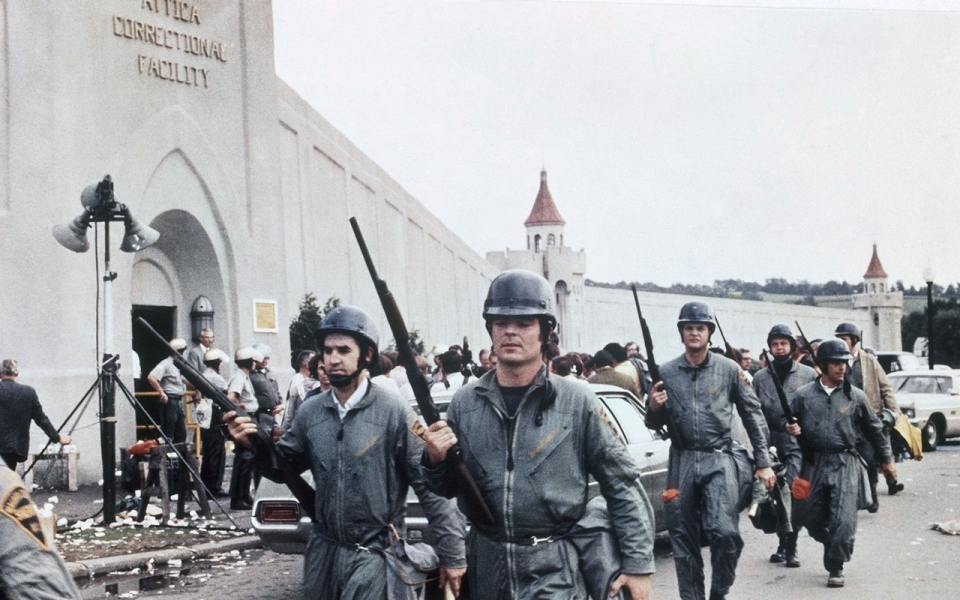
That was the day that the state police stormed Attica Correctional Facility in New York.
Four days earlier the inmates had taken over the prison.
One guard was killed.
The guards were members of AFSCME Council 82.
The prisoners demanded improvements to their brutal living conditions in the overcrowded prison.
Police retook most of the prison.
But the inmates held guards hostage in Cell Block D.
One of the prisoners, Elliot James Barkley explained the takeover.
“We are men. We are not beasts and we do not depend to be beaten or driven as such. The entire prison populace, that means each and every one of us here, have set forth to change forever the ruthless brutalization and disregard for the lives of the prisoners here and throughout the United States.”
When the state police stormed the prison they dropped tear gas from helicopters.
They fired 3,000 rounds, firing on the prisoners and hostages indiscriminately.
They killed 29 inmates and 10 hostages.
The police claimed the prisoners had killed the hostages.
They also accused the inmates of committing atrocities against the guards.
Public outrage swelled against the inmates, including racially-charged hate directed at the black prisoners.
But autopsies proved that all those killed had been felled by police bullets.
Attica became rallying cry for those concerned about prison conditions.
It has been referenced by many in movies andsongs, including John Lennon’s Attica State
Monday Sep 12, 2016
Monday Sep 12, 2016
On this day in Labor History the year was 1997.
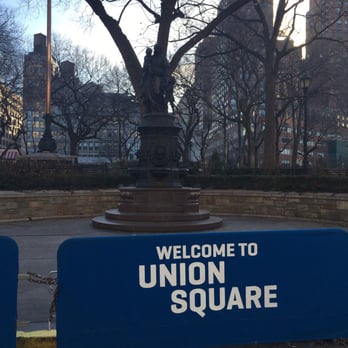
That was the day that Union Square in New York City was named a National Historic Landmark.
Republican Governor George Pataki explained the importance of the park in a press release.
“It is only fitting that the National Parks Service should recognize Union Square Park’s long history as a focal point for political expression. New York is proud that the first Labor Day Parade took place here in Union Square Park more than a hundred years ago, establishing a tradition that spread across the nation.”
Although the park was very important to the labor movement—that is not why it is known as “Union Square.”
The park got its name because it was the place of intersection, or union, of two busy New York roads—what are today Broadway and Fourth Avenue.
In 1831 the open space at the intersection was declared a public space.
The space became an important location for labor rallies and political demonstrations.
In 1882, the first Labor Day parade in U.S. history marched through the square.
10,000 workers waiving their banners high. In 1911, Union workers again gathered in Union Square to protest after the Triangle Shirtwaist Factory Fire killed 146 mostly young women and girls, some garment worker as young as 11 and 14 years old.
In the later 1920s the park was demolished for the construction of the New York Subway.
But the space continued be important to the city’s union movement.
In 2002, a series of twenty-two bronze plaques were dedicated at the park to tell the history of Union Square.
One of those plaques tells of the first Labor Day parade.
Another is a collage of images of labor demonstrations and sheet music of labor songs.
Sunday Sep 11, 2016
Sunday Sep 11, 2016
Saturday Sep 10, 2016
Saturday Sep 10, 2016
Friday Sep 09, 2016
Friday Sep 09, 2016
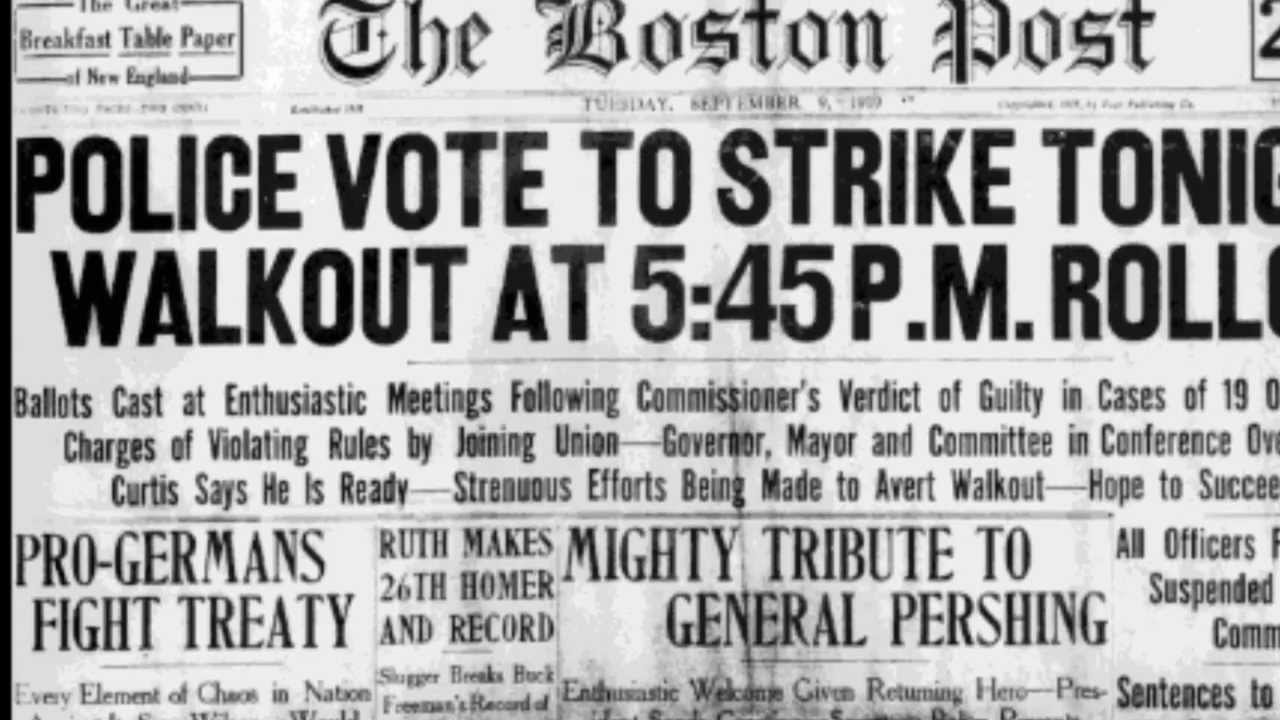
On this day in Labor History the year was 1919.
That was the day that the Boston police went out on strike.
The police in Boston had not had a raise for over six years.
They worked long shifts, sometimes even more than 80 hours a week.
The police force was predominantly Irish.
Many had served as US soldiers in World War I.
Fed up with their working conditions the police formed a union and joined the American Federation of Labor.
Boston’s Police Commissioner Edwin U. Curtis refused to recognize the police union and fired nineteen police officers for their organizing efforts.
In response the new union voted overwhelmingly in support of a walkout.
More than 1,100 police officers voted to strike with only 2 voting no.
Across the country newspapers made dire predictions about the collapse of law and order.
While there was an upsurge in crime due to the lack of police on the streets, the press wildly exaggerated what was happening in Boston.
Newspapers ran stories about gangs running wild with rioters and communists attacking women, fueling Red Scare fears.
The entire labor movement came under attack.
Massachusetts Governor Calvin Coolidge declared, “There is no right to strike against public safety by anyone, anywhere, anytime.”
His hardline stand against the striking police helped propel him to the national stage and eventually to the oval office.
The striking policemen were fired and replaced with unemployed WWI veterans.
In response to the national outcry over the strike, the AFL revoked the charters for other police unions.
The Boston police strike is subject of the page-turner The Given Day by author Dennis Lehane.
A fictionalized account of the events surrounding the strike, the novel follows the experiences of one Irish policeman during this tumultuous time.
Thursday Sep 08, 2016
Thursday Sep 08, 2016
Wednesday Sep 07, 2016
Wednesday Sep 07, 2016
On this day in Labor History the year was 1916.
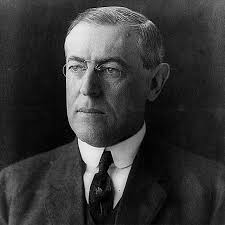
That was the day that the Federal Employees Compensation Act was signed into law by President Woodrow Wilson.
The act was sponsored by Senator John Kern, a Democrat from Indiana, and Daniel McGillicuddy, a Democratic Congressman from Maine.
The act provided compensation for federal civil service employees that lost wages because they were hurt or killed on the job.
There was great debate at the time over whether employees injured at work deserved to be compensated.
Before the turn of the twentieth century, those who sustained workplace injuries had little recourse.
Employers blamed workers for accidents and typically refused compensation leaving families destitute.
Edward Gainor, the President of the National Association of Letter Carriers explained the debate around the 1916 proposal saying, “The only question, the fundamental question, involved in this discussion is whether or not society should bear the burden of the injured worker in any industry.”
Increasingly, some lawmakers were beginning to make the case that society should indeed bear that burden.
Workers and labor leaders organized around issues of work place safety and demanded a compensation if they were injured on the job.
The law providing such a safety net for federal employees passed through the House of Representatives by an overwhelming margin of 288 to 6.
Although the Act only applied to federal employees, it was an important step forward in recognizing that all workers deserved to be compensated for workplace injuries.
The federal Office of Workers Compensation Programs that operates today traces its history directly back to the 1916 act.
And because of this 1916 act some Three million federal employees and their families are covered under the acts protections.
Tuesday Sep 06, 2016
Tuesday Sep 06, 2016
On this day in Labor History the year was 1860.
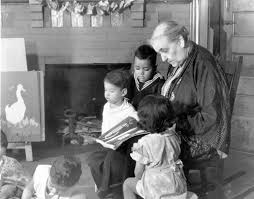
That was the day that Jane Addams was born in Cedarville, Illinois.
Her family was wealthy and her father served as a state senator.
In 1881, Jane Adams visited London with her friend Ellen Gates Starr.
There the two women were inspired by Toynbee Hall, a settlement house which worked with the poor and working class in the city.
They decided to establish a similar effort in Chicago.
They founded Hull House in an immigrant neighborhood of Italian, Greek and Jewish workers.
Hull House grew to become a complex of facilities that offered kindergarten, day care, lectures and cultural programs, and an important space for women trade unionists to hold meetings.
The women of Hull house became oneof the leading proponents for workplace safety in the nation, pushing for laws and reforms to help workers.
During the 1894 Pullman workers strike, Jane Addams visited the community and had meals with the women workers.
She was able to convince the workers’ strike committee to agree to sit down to arbitration, but the Pullman company officials staunchly refused to negotiate.
The refusal of the company to bargain, and the rising anger of the workers was an eye-opener for Jane.
Later she reflected, “During all those dark days of the Pullman strike, the growth of class bitterness was most obvious.”
Before the strike, she wrote, “there had been nothing in my experience [that had]reveal[ed] that distinct cleavage of society which a general strike at least momentarily affords.”
In 1931 Jane Addams was awarded the Nobel Peace prize for her life-long advocacy for working class women and children and her strong stand for peace during World War I.
Monday Sep 05, 2016
Monday Sep 05, 2016
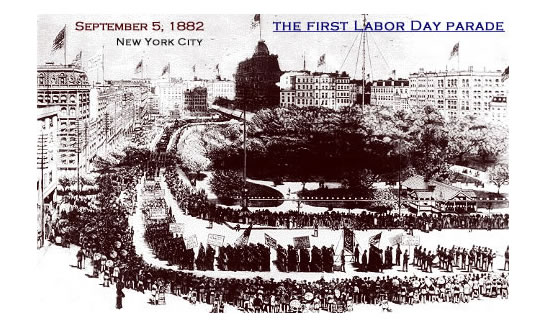
On this day in Labor History the year was 1882. That was the day the first Labor Day celebration and parade took place in New York City. The New York Sun printed a vivid report of the parade of 10,000 marching workers.
The paper described “men wearing regalia, men with society aprons, and men with flags, musical instruments, badges and all the other paraphernalia of a procession.”
The article went on, “As far ahead as one could see and as far down the side streets as forms and faces could be distinguished the windows and roofs and even the lamp posts and awning frames were occupied by persons anxious to get a good view of the first parade in New York of workingmen of all trades united in one organization. All along the line cheers were sent up.”
The reporter described the colorful banners carried by each trade union, and noted that following the bricklayers came “two decorated wagons containing brick arches. On each side of one of the wagons were the inscriptions: “Eight hours for work, eight hours for rest, and eight hours for recreation,” and “Get on to it the Union will never surrender.”
From New York the idea of setting aside a holiday for workers spread.
Oregon became the first state to officially recognize the holiday in 1897.
Colorado, Massachusetts, New Jersey and New York established a Labor Day that year as well.
By 1894 twenty-three more states celebrated the workers holiday.
It was that year, that President Grover Cleveland declared it a national holiday, in response to the Pullman Strike and Boycott that began in Chicago.
Labor Day is day to honor the sacrifices made by labor fighting for safe and fair workplaces.
Sunday Sep 04, 2016
Sunday Sep 04, 2016
On this day in Labor History the year was 1949.
That was the day known in New York as the Peekskill Riots.
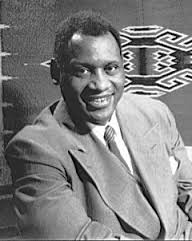
Internationally renowned African American Paul Robeson was scheduled to give an open-air concert.
He was known for his deep, moving voice singing iconic songs like Shenandoah and the Ballad of Joe Hill.
Robeson was active in the causes of civil and labor rights.
In the Cold War hysteria after World War II, Robeson had been labeled a dangerous Communist.
The New York concert was originally planned to benefit the Civil Rights Congress.
The group had been defending the “Trenton 6” a group of six black young men sentenced to die in New Jersey for allegedly killing a white shop keeper.
The case was rife with legal abuses.
But protests over the concert led to its cancellation.
It was rescheduled, and the tickets were distributed to trade unionists in New York City.
On the day of the concert 2,500 union members made a human wall around the field to protect against protesters.
Protesters gathered hurling anti-black and anti-Jewish racial epithets.
Pete Seeger opened the concert followed by Robeson.
The real trouble came when the concert ended and people tried to leave.
The protesters threw rocks at the passing cars, while policeman stood by and watched.
145 people were injured.
Other concerts were cancelled.
Paul Robeson would continue to be harassed by the FBI.
He was denied a passport due to his stance against anti-black discrimination in the United States and against colonialism in Africa.