
A daily, pocket-sized history of America's working people, brought to you by The Rick Smith Show team.
Episodes
Thursday Oct 07, 2021
Thursday Oct 07, 2021
On this day in labor history, the year was 1917.
That was the day Civil Rights leader Fannie Lou Hamer was born in Montgomery County, Mississippi.
She was the youngest of 20 children.
Her parents were sharecroppers and she began working the fields at the age of six.
At the age of 12, Fannie had to drop out of school to sharecrop to meet the needs of her family.
Marrying in 1944, she and her husband continued to work as sharecroppers on a plantation near Ruleville.
After decades of abject poverty and Southern political repression, Fannie Lou Hamer joined up with voter registration activists in 1962.
When she and seventeen others traveled to Indianola to register, Fannie was fired from her job and driven from the plantation she had worked at for decades.
She began working with the Student Non-Violent Coordinating Committee and played a central role in organizing Freedom Summer.
In a short time, Fannie was repeatedly arrested, beaten and shot at for her activism.
She suffered kidney damage after police beat her nearly to death in a Winona, Mississippi jail as she traveled home from a literacy workshop.
By 1964, she helped to found the Mississippi Freedom Democratic Party, which challenged the all-white delegation to the Democratic Convention.
President Lyndon Johnson was so threatened by live testimony she was giving before the Convention’s Credentials Committee, that he orchestrated an emergency press conference to preempt the broadcast.
When the Committee attempted a backroom deal to seat just two MFDP delegates with no voting rights at the convention, Hamer and other delegates left in disgust.
Hamer continued her activism but her life was tragically cut short in 1977 from hypertension and breast cancer.
She was just 59.
Tuesday Oct 05, 2021
Tuesday Oct 05, 2021
On this day in labor history, the year was 1886.
That was the day Henry George accepted the nomination to run for mayor of New York on the United Labor Party ticket.
In cities across the country, trade unionists met to found state labor parties and to hammer out political platforms for local and state elections.
In New York City, ULP advocates issued the Clarendon Hall platform and nominated Henry George as the ULP candidate for the mayoral race.
George had gained prominence with the 1879 publishing of his book, Progress & Poverty.
In it, he addressed private land ownership as the basis for inequality and advocated for a single tax system.
At New York’s Cooper Union that evening, where thousands of supporters gathered, George addressed the crowd.
He presented the ULP platform: higher pay, shorter hours, better working conditions, government ownership of railroads and communications and an end to police repression.
Burrows and Wallace describe the scene that night in their book, Gotham: A History of New York City to 1898.
During his speech, George declared that, “this government of New York City—our whole political system is rotten to the core.”
He argued that “politicians had made a trade out of assembling votes and selling them to powerful interests; what business got in return was police protection, lax enforcement of housing and health codes, friendly judges and fat franchises. To purify the political order, working class voters had to sever ties to all the established parties and choose from their own ranks.”
For a party that had just been founded weeks before, George came in second.
But like its sister organization in Chicago, the New York ULP would split over the issue of socialism within a year.
Monday Oct 04, 2021
Monday Oct 04, 2021
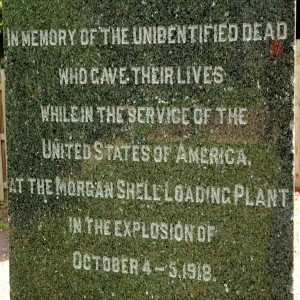
On this day in Labor History the year was 1918.
That was the evening that a series of explosions began at the T.A. Gillespie Company near Morgan, New Jersey.
The explosions would destroy the plant and 300 buildings and kill an estimated 100 people.
The world was embroiled in war.
The Unites States had entered the global conflict the year before.
The nation’s factories were churning out munitions and other supplies for the war effort.
On that fateful evening at Gillespie, workers were loading shells at the sprawling complex of 700 buildings that covered more than 2,000 acres.
The initial explosion was likely an accident.
Regardless the explosion was so severe that it cut the water lines to that part of the plant.
Without water pressure, fire fighters struggled to douse the flames.
A chain reaction of explosions touched off as the fire spread in the plant.
Houses in the nearby town shook from the massive explosions.
Windows exploded and residents fled.
Residents from three towns were evacuated due to the disaster.
The New York Sun described the exodus as “streams of human misery—mothers and fathers, frightened children clutching still more frightened dogs; old, old people tottering along, all with the same dazed expressions on their faces, as if they scarcely realized what had happened.”
When the fire was finally put out, nearly half of the plants buildings were destroyed.
It was impossible to say exactly how many workers were killed, so bad was the carnage.
Two members of the US Coast Guard died responding to the disaster.
The disaster was then compounded, when a flu epidemic swept through the residents evacuated from nearby towns.
The death toll and misery from these tragic events mounted even higher.
Sunday Oct 03, 2021
Sunday Oct 03, 2021
On this day in labor history, the year was 1932.
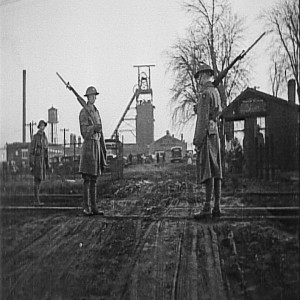
That was the day the State Militia was called into Kincaid, Illinois.
164 high school students had just walked out of the classroom, declaring themselves on strike.
They were protesting the school board’s use of coal from the Peabody Coal Company.
The students walked out in solidarity with their fathers, who were on strike against the Peabody Coal mine in nearby Langleyville over wage concessions.
The father-son strike, as it was referred to, was one more in a series of protest actions that came on the heels of the founding of the Progressive Miners of America a month earlier.
Thousands of Illinois miners had just voted with their feet to repudiate John L. Lewis’ UMWA over wage concessions.
After their founding conference, new PMA leaders began aggressively organizing non-union mines.
They marched into mining towns and ordered non-union diggers out of the mines.
They also struck UMW mines, picketing against the industry standard of $5 a day that had been set by the latest concessionary contract.
At some mines, the PMA was able to win the old $6.10 a day wage.
Throughout the month, the State National Guard had been called out to a number of mining towns to quell armed conflicts between PMA and UMW supporters.
The Peabody Coal mine at Langleyville had been shut down for months by ongoing PMA/UMW conflict.
Now it had reopened under heavy National Guard protection and was the only mine operating in Christian County.
The striking fathers were PMA miners picketing the continued mine operations under the UMW concessionary contract.
The years-long Illinois mine wars had just begun.
Saturday Oct 02, 2021
Saturday Oct 02, 2021
On this day in labor history, the year was 1949.
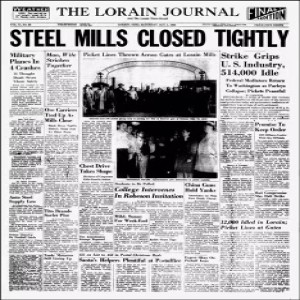
That was the day Americans awoke to fears the nationwide steel strike would spread rapidly to include key fabrication plants.
Half a million steel workers had joined 400,000 coal miners on strike the morning before.
The miners’ resolve to defend their $100-a month pensions, instituting what John L. Lewis called the “no-day work week,” emboldened the steel workers to walk out of the mills.
Within 24 hours, 96% of all steel production in the country was completely shut down.
USW contracts were due to expire on the 15th, But the writing was on the wall.
The mill owners decried anything close to mine pensions as nothing short of socialistic and refused to budge in negotiations.
USW president Phil Murray thundered that those companies that failed to agree to demands for non-contributory pensions and insurance would be shut down.
But militants warned that President Truman’s Fact-Finding Board had already watered down strike demands.
The President’s Board had been established to put off two previous strike deadlines.
The ‘guidelines’ it issued only encouraged steel magnates to stand tough against USW demands.
These included a 30-cent raise plus increased company insurance and pension contributions.
Now it had become a defensive struggle over whether steel workers would have to begin contributing to health and pension plans through wage cuts.
By the time steelworkers ended their strike forty-two days later, they had won the $100 a month pension, minus what they would receive from social security.
And they had to begin contributing to a health insurance plan with no wage increase at all.
Still, workers celebrated that they had successfully defended the USW against the all out union-busting drive.
Friday Oct 01, 2021
Friday Oct 01, 2021
On this day in Labor History the year was 1851.
That was the day that William Henry, a black cooper, or barrel maker who went by the name of Jerry was arrested in Syracuse, New York.
First he was told that he was being arrested for theft.
But then he learned that federal marshals had arrested him for violating the Fugitive Slave Law, passed the year before.
Jerry had escaped slavery in Missouri.
The anti-slavery Liberty Party was holding its convention in nearby church.
When word came about Jerry’s arrest, a crowd rushed to release him.
Once released he was quickly recaptured and returned to custody.
But then a large crowd, numbering more than 2,000 gathered to free Jerry from the office where he was being held.
According to research done by the Syracuse University Library, the first person into the office was J. M. Clappe, an iron worker likely chosen for his brawn.
The crowd was able to free Jerry and hide him until he could escape into Canada.
Clappe also had to flee to Canada to avoid arrest, along with eight others.
Nineteen people were indicted for participating in the rescue.
Only one person was convicted, and he died before he could appeal.
In turn, the abolitionists won an indictment against the marshal who had arrested Jerry.
They charged him with kidnapping.
Although the marshal was acquitted, it gave the abolitionists a chance to publicly challenge the constitutionality of the Fugitive Slave Act.
Each year until 1858 a Jerry Rescue celebration commemorated the event.
Abolitionists referred to the “Jerry Level” as a standard for justice.
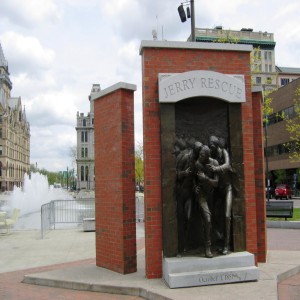
In 2001 a monument to the rescue was dedicated in Clinton Square, in downtown Syracuse New York.
Thursday Sep 30, 2021
Thursday Sep 30, 2021
On this day in Labor History the year was 1919.
That was the day that began the Elaine Massacre.
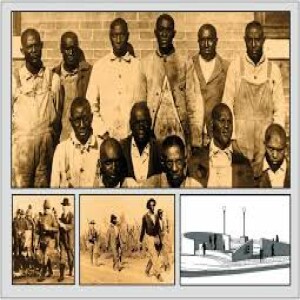
The massacre took place in Arkansas, where more than 100 black farmers and sharecroppers were gunned down for daring to organize their labor.
The Year before, a black farmer by the name of Robert L. Hill had founded the Progressive Farmers and Household Union of America.
Union members pooled their money to purchase land.
They also hired a lawyer to sue planters who did not give black tenant cotton farmers their fair share of the profits.
The group grew in membership in the Arkansas delta region, including near the town of Elaine in Philips County.
But white landowners would not allow this challenge to their power.
Armed white militias came to a church where the union was holding a meeting.
The black attendees were also armed.
Gunfire broke out.
In response, white posses and federal troops unleashed a wave of terror across Philips County.
Hundreds of black residents were arrested.
At least 100 black Arkansans were killed.
Some estimates of those murdered is considerable higher.
Five white people also died.
122 black men and women were charged with murder.
Twelve were given the death sentence.
No white vigilante was ever charged.
The convicted African Americans appealed their cases.
One appeal for six of the defendants went all the way to the US Supreme Court, where it was overturned in a landmark ruling.
The year of 1919 was one of the deadliest years of violence against African Americans in U.S. history.
Civil Rights activist James Weldon Johnson called those bloody months the “Red Summer.”
Twenty-six race riots left thousands of African Americans homeless and hundreds dead from Chicago to Washington D.C. to Omaha.
Wednesday Sep 29, 2021
Wednesday Sep 29, 2021
On this day in Labor History the year was 1789.
That was the day that the United States Congress officially created the United States army.
Not everyone agreed that the U.S. should have a standing army.
Two years earlier, at the meeting that drafted the U.S. Constitution, James Madison warned against a permanent federal army.
He told those at the Constitutional Convention in Philadelphia “A standing military force, with an overgrown Executive will not long be safe companions to liberty.”
Since Madison was a strong proponent of a centralized federal government, his caution about the army was noteworthy.
Perhaps these warnings is why it took Congress until the last day of their session to finally approve the measure.
In fact, President George Washington had to write Congress not once but twice to get them to act on the issue.
Once it was approved, the first standing Army had about 800 members.
By comparison, in 2015 the Army had just under half a million in active duty soldiers.
To supplement the small army, Congress also made a provision for the President to call up troops from State militias.
A stated purpose for such call ups, was “protecting the inhabitants of the frontiers of United States from hostile incursions of the Indians.”
While in federal service, the State militias were supposed to receive “the same as the pay and subsistence” as the regular army.
One time various State militias were used was for the forced removal of the Cherokee people from the Southeast on the Trail of Tears in the 1830s.
State militias were also deployed to break up labor strikes, such as in the Homestead Strike in Pennsylvania in 1892.
Tuesday Sep 28, 2021
Tuesday Sep 28, 2021
Would you be willing to stand up in solidarity with your fellow workers, even if it cost you your job?
On this day in Labor History the workers at Mersey Docks and Harbor Company in Liverpool, England answered that question.
The year was 1995.
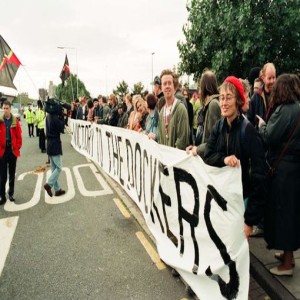
329 Mersey Dock workers refused to cross a picket line that was being walked against another company on the docks.
The workers at Torside had been fired for protesting against erosions in job security and increasingly unpredictable scheduling.
They were speaking out against the casualization of their labor.
When the Mersey Dock workers would not cross the Torside picket line, they too were fired.
Dock workers across the world stood up in solidarity with the Mersey workers against this unjust treatment.
They knew if it could happen in Liverpool, it might happen anywhere.
Pickets sprung up from Norway to Japan, from Australia to Italy and into the United States.
It was a global outpouring of solidarity.
The strike wore on for 850 days.
One year in to the strike, dockworkers held an international day of action in support of the Liverpool workers.
Finally, two-and-a-half years after they were fired, the dockworkers agreed to a settlement.
They did not get back their jobs.
But they did get severance pay.
A film was made about the struggle.
The proceeds were used to purchase a bar in Liverpool.
It is known as the Dockers Pub, and has become a space for working class organizing.
The International Dockworkers Council was also born from this strike.
Today the council has 90,000 members—a lasting movement of solidarity.
Twenty years after the strike, dockworkers from across the world gathered in Liverpool to remember the struggle.
Monday Sep 27, 2021
Monday Sep 27, 2021
On this day in Labor History the year was 1903.
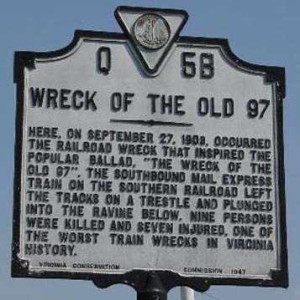
That was the day that is remembered in Virginia as the “Wreck of old 97”.
Old 97, also known as the Fast Mail, was a Southern Railway freight train.
It carried the mail from Washington D.C. to Atlanta, Georgia.
The train wreck happened on the leg of the trip from Monroe, Virginia to Spencer, North Carolina.
The train had come in late to Monroe.
It was reported that the railway company ordered the engineer to increase the speed of the train to make up time.
The company had to pay a penalty for delivering the mail late.
But when the trained neared Danville, Virginia the tracks curved at the Stillhouse Trestle Bridge.
The speed was too much.
Despite the engineer’s efforts to slow the train, it careened off the tracks and plummeted to the rocky ravine forty-five feet below.
Eleven of the sixteen people on board the train died, including the conductor, the engineer and the flagman, and both firemen.
The railway company blamed the wreck on the deceased engineer.
Newspapers across the country carried photos of the wreck.
The disaster became the subject of multiple ballads.
One version by Vernon Dalhart in 1924 is thought to be the first million-selling country record in the United States.
Johnny Cash recorded another well-known version of the song.
In 1993 an alternative country band took the name the “Old 97’s” harking back to the disaster and the songs it inspired.